View this email in your browser
|
 |
The Deep DishAn insider look at food and farming from Civil Eats Issue 28, May 2024: Plastic, Part 2: Same Problems, Some Solutions
|
|
|
|
|
The Editors' Desk
|
Plastic pollution has contaminated nearly every speck of Earth’s soil and water, our food, and human bodies—and our understanding of its impact on all living things is still developing. At the same time, the situation adds to the climate crisis, with greenhouse gas emissions from plastic production expected to more than double by 2060.
Our food system is a major contributor to the mess we’re in: Most plastic waste is food packaging. That’s why, back in 2021, we devoted Issue No. 2 of The Deep Dish to plastics, covering PFAS (aka “forever chemicals”) in plastic food containers, microplastics in soil, plastic-free grocery shopping, and much more.
New information about the scope of the problem keeps on coming, though; as we were going to press, this unnerving report on microplastics reached our desks. Fortunately, news about solutions continues to flow, too, including the completion—set for the end of this year—of an international treaty to tackle the plastics crisis.
To bring you the latest developments, we return to plastics in this issue of The Deep Dish. We track how microplastics from automotive tires end up in your food and how plastic equipment in farming could be harming the soil, plants—and you. On the hopeful side, we interview a plastics-waste expert about a new AI tool that could help policymakers drastically reduce plastic pollution. We also visit a new crop of truly inspiring plastic-free grocery stores, profile a pioneering recycler, and explore the growing business of reusable takeout containers.
We know the plastics problem is terrifying, but we also know that continuing to expose it—and uncover possible solutions, too—brings us all closer to figuring it out. Your membership in Civil Eats makes this work possible. Thanks for reading, and if you’d like to increase your support for our work with a tax-deductible donation, please click the button below.
As always, we look forward to hearing your thoughts, comments, and ideas, and we’ll be back in June, with a preview of our summer reading guide.
~ The Civil Eats Editors
|
|
Donate Today
|
|
|
|
|
Member Updates
|
Next Month: A Deep Dish and Salon on Summer Books
In the next issue of The Deep Dish, we will share a sneak preview of our summer book guide and will be shortly announcing a companion salon, featuring some of the authors we plan to profile. We would love to also include your 2024 recommendations for food-related books or cookbooks. Please send them to members@civileats.com.
Last month, we welcomed chefs and authors Kim O’Donnel and Bryant Terry to our salon to share their helpful ideas on ways to reinvigorate home cooking. If you weren't able to attend (or you loved it so much you can't wait to watch it again), you can view the recording here.
Membership Survey
Thank you to all who responded to our membership survey! We appreciate that you value our work and gave The Deep Dish 4 out of 4 stars. We’re implementing your feedback to enhance the membership program, so stay tuned for more announcements. If you would like to share more about how we can improve or what we’re doing well, send us an email.
Connect With Other Civil Eats Members
Join our members’ Slack Community to connect with others who care about food systems. You will also be the first to receive behind-the-scenes access to our reporting. To participate, please review the Community Rules and Agreements and accept this invitation link. (Here are the instructions if you’re using Slack for the first time.)
|
|
|
|
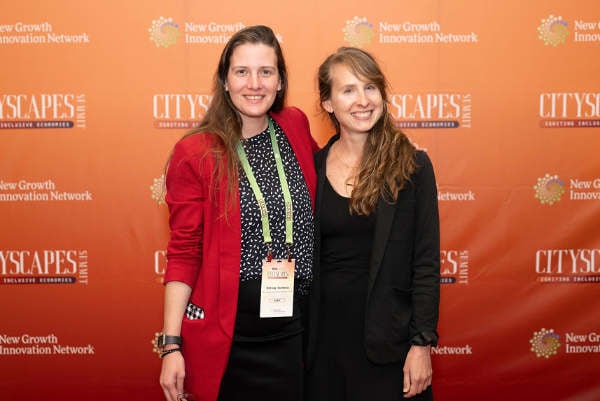 |
Betsey Suchanic and Mari-Kate Mycek
|
Member Spotlight: Mari-Kate Mycek and Betsey Suchanic Bring ‘Walanthropy’ to Their Book Club
BY JIM COLGAN
|
The discussion had every chance of being depressing. But instead of feeling hopeless, the 10 members of a virtual book club for the economic development nonprofit New Growth Innovation Network (NGIN) left feeling optimistic. The assigned reading wasn’t actually a book, but Civil Eats’ recent investigative series Walanthropy, about Walmart
and the Walton Family Foundation’s influence over the American food system.
“It seemed like such an easy connection between economics and the food system, and [it provided] an opportunity for the team to really dig into how those things intersect,” said Mari-Kate Mycek, an adviser at NGIN who organized the book club—and pitched the Walmart series to the group—along with her colleague, Betsey Suchanic. Both are longtime Civil Eats readers and supporting members.
Suchanic said they left their book-club meeting with some empowering questions: “What are ways that we feed into the system? Not just where we shop, but where is our money being invested?”
While NGIN focuses on economic development in American communities, Suchanic and Mycek are both passionate about food issues and often look for ways their work at NGIN can encompass those topics.
Suchanic, who lives in Washington, D.C., grew up in a Philadelphia suburb and never thought much about food until she started spending two weeks each summer on her grandfather’s dairy farm.
“That was a real eye-opening experience for me in terms of just thinking about where our food came from and thinking about farming as a profession,” she said.
The experience also came in handy when she got her first economic development job—helping new farmers get off the ground in rural Virginia.
Mycek, who lives in Schenectady, in upstate New York, has a vegetable garden “big enough to call a small farm,” she said. Her interest in food began when she researched food security among immigrant communities as part of earning a Ph.D. in sociology.
“Something that really struck me doing that research was, so often the food that people can afford to buy is not necessarily the food they care about or their family cares about,” she said.
When people don't have access to the foods of their heritage, said Mycek, it can affect their ability to express their own culture. “You're hitting not just the barrier of, ‘I feel hungry,’ but the barrier of, ‘I can't be who I want to be.’”
Mycek said she’s grateful she’s in a position to grow the produce that allows her to express her own cultural values and to share the food she grows whenever she can. “If you lived near me, I'd be dropping lettuce off on your front porch.”
For both women, and for the book group they created, discussing the Walanthropy series could have left members feeling overwhelmed by the immensity of the food system and the limits to what any of them could do. Instead, a different mood prevailed.
Quoting her book-club colleague Cuevas Peacock, Suchanic said, “We as individuals cannot change the system. But that doesn't mean that we can't be creative in redesigning or reimagining a new system.”
|
(return to top)
|
|
|
|
|
|
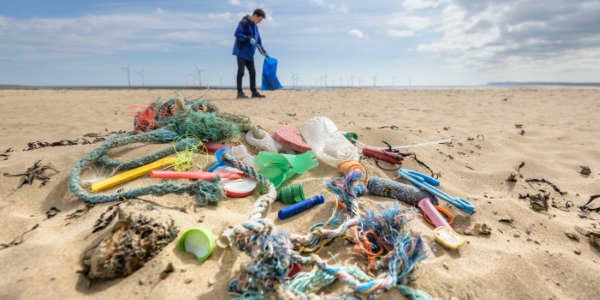 |
The Check-In: Can AI Help Cut Plastic Waste From the Food System?
U.C. Santa Barbara researcher Nivedita Biyani believes solutions start with the right data.
BY LISA HELD
|
In April, representatives of more than 150 countries traveled to Canada to hammer out the details of an international, legally binding treaty to tackle the plastic crisis. It was the fourth of five negotiation sessions, with the process set to be completed later this year.
If all goes according to plan, the result will be a Paris Agreement for plastic.
Just like during international climate summits, the companies driving the crisis are showing up in numbers to try to shape the outcome of the negotiations. Also familiar: Many advocates and experts say that treaty progress is not moving fast enough given the
urgency the situation demands. In a press release commenting on the April meeting in Ottawa, World Wildlife Fund (WWF) International pointed out that more than 15 million tons of plastic entered the ocean during the week of negotiations.
“Countries have made important progress in Canada with constructive discussions on what the treaty will actually do, but the big decisions still remain: Will we get the strong treaty with common global rules that most of the world is calling for, or will we end up with a voluntary watered-down agreement led by least-common-denominator values?” said Eirik Lindebjerg, WWF International’s global plastics policy lead. “Negotiators need to recognize that plastic pollution is an accelerating global crisis that cannot be solved with fragmented national approaches.”
Nivedita Biyani, an expert on plastic waste, was in Ottawa attempting to provide policymakers with data they could use to make smarter decisions.
Biyani has been working to understand and improve waste management for about 12 years, in poor neighborhoods in India that lack infrastructure, for the government of Singapore, and now as a researcher at U.C. Santa Barbara (UCSB), where she looks at “mass flows” of plastic—aka “how materials travel through production to end-of-life and become waste.”
Her latest project: the Global Plastics AI Policy Tool, developed with Douglas McCauley, the director of UCSB’s Benioff Ocean Science Laboratory, and Roland Geyer, a prominent industrial ecologist.
Building on a 2017 paper Geyer published that estimated how much plastic had ever been made, the team set out to show what kind of impact 11 policy interventions—including capping production, taxing plastic packaging, and investing in recycling infrastructure—would have on reducing plastic pollution through 2050. To do so, they used a machine learning model, a form of artificial intelligence, that included GDP and population data to model future years.
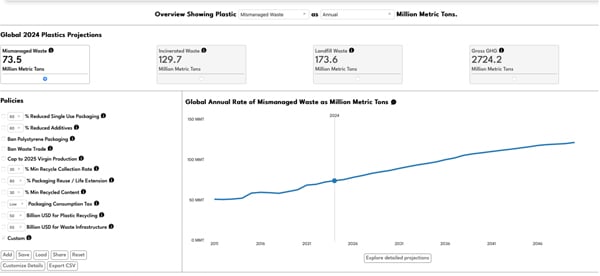
The tool estimates that in 2024, 129.7 million metric tons of plastic waste will be incinerated, 173.6 million metric tons will end up in landfills, and 73.5 million metric tons will end up in the environment. From there, without drastic changes to business as usual, the numbers just keep climbing.
Recently, Biyani spoke with Civil Eats to explain how policymakers (and others) might use the tool to reduce plastic waste from every sector, especially the food system.
Can you walk us through how this works?
We start the conversation with mismanaged plastic waste. In this model, mismanaged means it's in the larger environment, either on land or in the sea, basically not being managed the way it should be.
|
|
Click image for a larger version (opens in a new window)
|
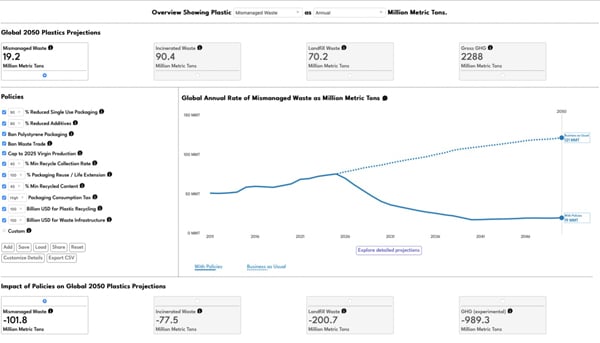
So, what you're seeing on this axis is you have 2011, and here you have 2050. You can look at, under business as usual, this is the trajectory. Here we are today, at 2024, and we're at roughly 60-70 million metric tons of mismanaged plastics waste into the larger environment. If we do not do anything, we are likely to reach about 121.5 million tons of mismanaged plastic waste by 2050.
[On the left side above,] you have a collection of 11 different policies like, for example, reduced single-use packaging, reduced additives, a cap on virgin polymer production, or implementing a minimum recycled content. You can even toggle the percentage. So, at its highest, for example, implementing a minimum recycled content mandate would reduce the mass of mismanaged plastic waste at 2050 from 120 million metric tons to 64. And we can toggle all the different policies and see what we get. [If we do everything], we get to something like 17 million metric tons, which is as low as it goes.
|
|
Click image for a larger version (opens in a new window)
|
|
|
When you look at this list of policies governments could implement and how each could reduce mismanaged waste, are there any that stand out as being the most effective at reducing the most waste?
Absolutely. Minimum recycled content [a little more than halfway down the list] is one of the biggest ones that actually reduces mismanaged plastic waste. This is saying that every piece of plastic that we put out should have a [20-40 percent] minimum recycled content of plastic in it. So, this is not only making sure things get recycled, but that the recycled mass is incorporated into new products. This is a big one.
Another one would be to cap virgin plastic production at 2025 levels. If we capped it, we would see a pretty significant delta, about 31 million metric tons of reduction of mismanaged plastic waste.
And then the other one would be waste infrastructure. This is really speaking to the fact that we need to implement systems and incentives to collect whatever we sell. That has a really big effect as well.
|
“What I'm trying to say is that waste is actually a supply chain.”
|
|
What I'm trying to say is that waste is actually a supply chain. No one thinks about it that way. It's material, it's useful material, and in this day and age where right now everything is so expensive . . . why are we wasting it?
We cannot keep doing waste management the way we’ve been doing it since the 1950s. Every single industry has changed, has had a disruption. Almost nothing we do right now is like we did in the 1950s except for waste management. Why has that not changed?
When you look at what is being recycled, even after all this time, it's almost nothing, and most plastic is actually not recyclable. Is it really possible to get to numbers like 40 percent recycled content in all new plastics?
There's one part of this process, which is the modeling aspect of it, the mass flows. The other is implementing the policies we've modeled, and that's a whole different conversation. When I was working for the government of Singapore, they had a lot of trouble trying to implement some of the policies we've talked about. They're not that easy, and it might be easier for some countries to implement than others.
One criticism I've seen of the treaty negotiations so far is that there is a lot of more emphasis on recycling and reuse and not as much on capping production. Based on the data, is it more important to cut production, and can we fix the plastic waste problem without capping?
We could get to 20 million metric tons of mismanaged plastic waste without capping production, but it's like trying to get all the water out of the house without turning off the tap.
A lot of the plastic waste in the food system is packaging. Is there a specific policy solution that shows the most promise in that sector according to your model?
Packaging reuse on its own does not have a very large impact on mismanaged plastic waste, but packaging reuse with a minimum recycled content mandate would result in a staggering decrease [from 121.5 to 56.5 million metric tons] in mismanaged plastic waste.
|
“We could get to 20 million metric tons of mismanaged plastic waste without capping production, but it's like trying to get all the water out of the house without turning off the tap.”
|
|
This is saying, “OK, how can we extend the life of one plastic packaging to not just one use?” It's saying, “Maybe we can get eight to 10 uses out of a plastic packaging and then send it for recycling.” And if you can do that, look at the effect you have. It's quite staggering. It's more than half in reduction as opposed to only reuse.
For example, if a very well-known coffee company that sells coffee everywhere in America would implement reuse and collect back the coffee cups and then send those for recycling after eight to 10 uses, potentially even 20 depending on the robustness of the plastic, then you would have a much bigger reduction.
This interview has been edited for length and clarity.
|
|
|
|
|
|
|
|
 |
A First Look: Tracking Plastics—From Road to Plate
A members-only look at breakthrough reporting, ahead of publication on our site.
BY VIRGINIA GEWIN
|
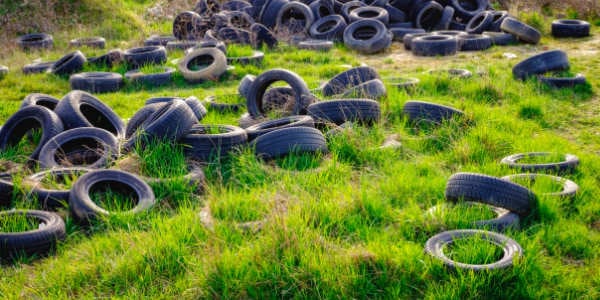
Microplastics have been found in human breast milk, placentas, and blood. These tiny particles, shed by plastic bags, cups, and other plastic items as they break down, can accumulate in organs including the lungs, heart, and brain once they are inhaled or ingested. In March, scientists revealed that people who had microplastics in their carotid arteries had a four-fold higher risk of heart attack or stroke. Perhaps not surprisingly, researchers are urgently trying to determine the degree of microplastic risk from the food system.
One of the primary culprits of microplastic pollution is an unlikely suspect: automotive tires. In April, at a press conference titled “Food Security, Water Woes, and Tire-d Lettuce” at the European Geoscience Union meeting in Vienna, Austria, researchers explained that modern tires contain hundreds of different chemical additives, many toxic, that make up an astonishing 50 percent of global microplastics.
The additives are designed to help tires last longer. But, explained Thilo Hofmann, an environmental scientist at the University of Vienna, the friction of braking causes the additives to be shed as microplastics. “What has been overlooked is that these compounds end up in the environment,” he said.
|
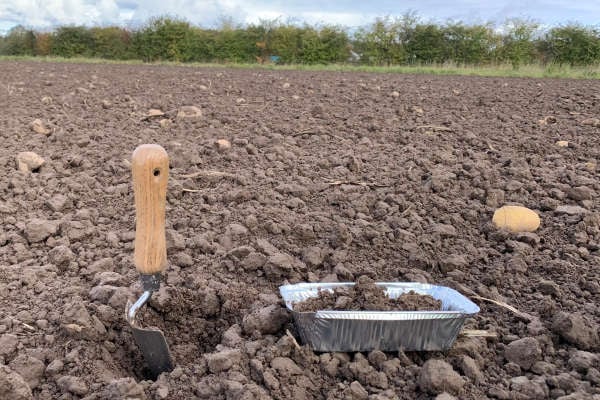 |
A field in the U.K. that was surveyed for microplastics in the soil.
(Photo courtesy of Samuel Cusworth)
|
Tires contain thousands of potentially toxic compounds, producing up to 2,000 times more particle pollution than tailpipes. One toxic tire compound, 6PPD-quinone, was linked to massive salmon deaths in Washington after storms washed tire particles into streams. In total, 0.8 kg (about 17.5 pounds) of microplastics are produced per citizen per year globally.
Over the last few years, Hofmann and his graduate students have been tracking the path of microplastics from the road to the dinner plate. The team first determined that five tire additives found in irrigation water could be taken up in the leaves of greenhouse-grown lettuces. In some instances, the plants also metabolized the chemicals, creating compounds not yet described or evaluated for health risks. “It’s impossible to test the toxicity and the uptake of all of these compounds,” said Hofmann.
Furthermore, tire producers do not disclose what additives they use in tires because that’s considered a trade secret. “[Tire additives] are not regulated, which may change in the coming years,” predicted Hofmann. In response to a lawsuit by the Yurok, Port Gamble S’Klallam, and Puyallup tribes, the U.S. Environmental Protection Agency (EPA) is currently reviewing 6PPD as tire makers scramble to come
up with alternatives. (Hofmann is unconvinced that alternatives will prove less toxic.)
Hofmann says there are three main routes for tire chemicals to get into food as it’s being grown: blown by wind from roadways into agricultural fields, via recycled wastewater, and through biosolids—the end-product of the wastewater treatment process that can be used as fertilizer. Many countries around the world, including the U.S., are dramatically increasing the application of biosolids to farmlands. Agriculture received roughly 40 percent of U.S. biosolids applications, 2.3 million metric tons, in 2018.
To help determine human exposures, Anya Sherman, Hofmann’s Ph.D. student at the University of Vienna, tested whether six different tire-derived chemicals were present in store-bought lettuces from four different countries, each with different biosolids application regulations.
She detected at least one of the six tire additives in the majority of samples. “The processes are so complex and there are so many different pathways by which contaminants can reach fields—we are nowhere close to understanding the full picture yet,” said Sherman.
Researchers are assessing the level of microplastics in other crops and cropping systems. Civil Eats will be publishing a closer look at this story soon.
|
(Return to top)
|
|
|
|
|
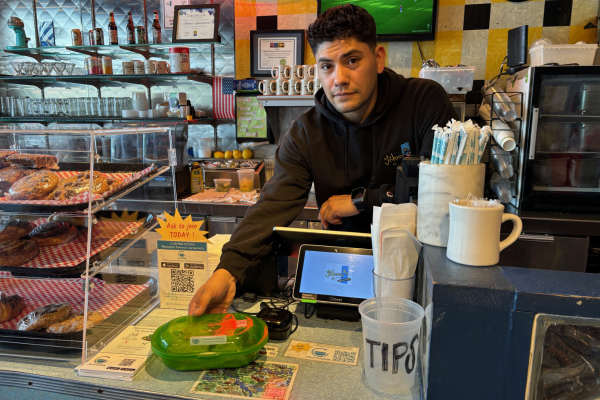 |
David Martinez, manager at Johnny's Luncheonette in Newton, Massachusetts, handing over a meal in reusable container. (Photo credit: Meg Wilcox)
|
A First Look: Restaurants Create a Mound of Plastic Waste. Some Are Working to Fix That.
BY MEG WILCOX
|
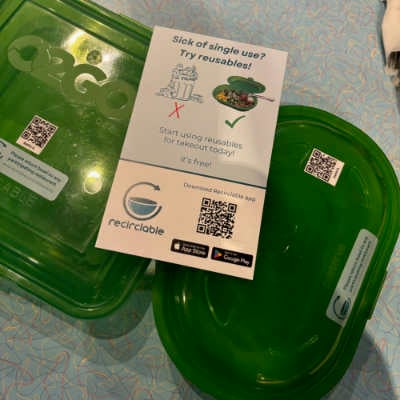
At Johnny’s Luncheonette, a family-style diner in the greater Boston area serving sandwiches and breakfast all day, customers can take their meal to go in a lime-green, durable plastic container that is borrowed like a library book and designed to be reused hundreds, if not thousands, of times by other restaurant patrons.
Customers don’t pay extra for the reusable take-out box. They simply need to download an app called Recirclable, and—to avoid paying a $15 fee—return the container within two weeks to one of 14 restaurants participating in Recirclable’s reuse program.
Johnny’s Luncheonette is one of a small but growing number of restaurants taking steps to move away from single-use plastic take-out containers, which usually end up in the trash because they can’t be recycled. Worse yet, mismanaged plastic waste eventually enters the oceans, where it kills sea creatures that ingest it and breaks apart into toxic microplastics lentil-sized or smaller.
Restaurants and food services use nearly 1 trillion pieces of disposable food service ware and packaging annually in the U.S., according to Upstream, a reuse advocacy organization.
Johnny’s Luncheonette began offering the reusable take-out containers earlier this year because its owner, Kay Masterson, was tired of the Sisyphean search for an environmentally friendly disposable take-out box. “Ideas like Recirclable are a much better option because it takes out the conversation of, ‘Well, which takeout container is less bad?’” she said. “Reuse is just smart. It’s smart resource-wise. It’s smart cost-wise.”
Masterson pays more per piece for the reusable packaging but said that she expects costs will drop below disposable packaging as more customers use the service. Thus far, only dozens of customers have selected the reusable option.
|
“Reuse is just smart. It’s smart resource-wise. It’s smart cost-wise.”
|
Many case studies show that while reusable containers cost more upfront, businesses start to save fairly quickly. What’s more, “It’s not just about saving money but about building resiliency so that you have shorter supply chains without so much global dependency,” said Elizabeth Balkan, director of Reloop America, at Reloop, a nonprofit operating in both Europe and
the U.S.
Moving from single use to reuse is one of the biggest opportunities for reducing plastic pollution, according to a report by the Ellen MacArthur Foundation, a reuse pioneer. Reuse services targeting food businesses are growing quickly in the U.S., especially for arenas and stadiums, colleges and K-12 schools, corporate offices, and other institutions.
Startups offering logistics and dishwashing are proliferating, as are nonprofit organizations providing strategic support, funding, and advocacy. But reuse is still far from the norm in the U.S. Communities need shared reuse infrastructure for the practice to pick up steam, according to Crystal Dreisbach, CEO of Upstream. Cohesive, city-scale systems could help shift consumer habits and increase the volume of materials being reused, which is essential for both economic and environmental impact. Enabling policies would hasten the transition.
“You can't have consumers running all over town, dropping off things in [different] places. You’re going to need big infrastructure that will accommodate this massive systemic change away from disposable to reusable,” Dreisbach said.
Reuse on the Rise
Reuse services are emerging in cities across the country, from the Bay Area to Brooklyn. Startups like Vessel and Turn Systems offer customers a reusable cup option at the point of sale that can be returned at kiosks or bins. DeliverZero provides reusable
take-out containers at some 150 restaurants in New York City, Boulder, Colorado, and California, and at Whole Foods stores in Boulder. Usefull offers stainless steel containers on college campuses. Bold Reuse services large venues in Portland, Oregon, Seattle, Kansas City, and Phoenix, while Dispatch Goods
in San Francisco and ReUso in Chicago serve restaurants and institutions.
|
|
|
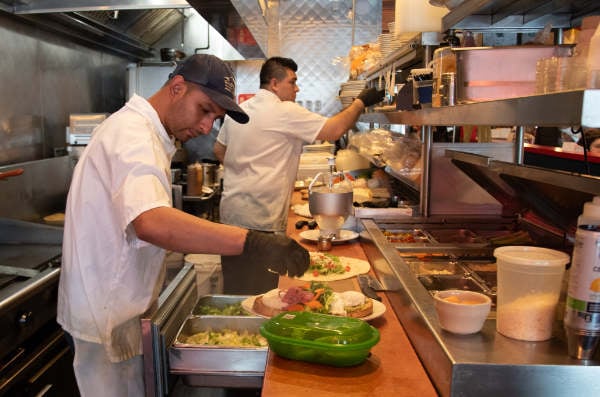 |
In the kitchen at Johnny's Luncheonette with a meal to go in a reusable container.
(Photo credit: Meg Wilcox)
|
|
Dishwashing and sanitizing systems are also emerging, since they’re key to any reuse system. Restaurants handle their own dishwashing in Recirclable’s system. Other reuse companies provide dishwashing, including via mobile units at large venues, or contract it out to large washing stations like
Re:Dish, which operates in New York City and Philadelphia and is equipped with technologies for tracking and sorting packaging.
ReThink Disposable provides free reuse consulting to restaurants, institutions, and large venues in Minnesota, California, Pennsylvania, New Jersey, and New England. The nonprofit also raises funding to buy reusable packaging and/or install dishwashers at restaurants and food delivery programs run by nonprofits, such as Truro Community Kitchen.
Reusable containers come in ceramic, glass, stainless steel, and plastic, depending on the venue, but, for takeout, “most restaurant owners prefer durable, No. 5 plastic [polypropylene type] because they store and stack easily,” are lightweight, and can be microwaved, said Amber Schmidt, New England zero-waste specialist at ReThink Disposable.
While “reusable plastic may be an imperfect solution, it is still a critically important step in the right direction,” toward an overall reduction in plastic packaging, Balkan said.
Volume Is Key
Recirclable was co-founded in 2021 by Margie Bell, who worked for decades on ecommerce and point-of-sale applications in the software industry. “Our vision was, ‘Let's have this happening at every restaurant and, like library books, you borrow at one and you return to another.’”
Recirclable’s volume is small. Its users are dedicated customers who follow it from restaurant to restaurant, Bell told Civil Eats. “We're in the thousands—and we’d love to be in the tens and hundreds of thousands—but we have to grow the network” of restaurants.
|
“Reusable plastic may be an imperfect solution, [but] it is still a critically important step in the right direction.”
|
“The biggest hurdle with Recirclable is just getting the word out there and changing habits,” said Masterson.
Recirclable’s small network of restaurants also limits its growth. Customers must live near a restaurant where they can return the container, or the system doesn’t work for them. The number of steps required is another barrier. Johnny’s Luncheonette Manager David Martinez said that when some interested people learn they have to download an app and put in their credit card, they decline.
“We recognize that can cause friction,” said Bell, who won an award from the EPA to develop a new system, launching this year, that will be accessed with one tap of a credit card.
Recirclable is not alone in having difficulty reaching volume—“the cornerstone” of reuse, Dreisbach said. “You cannot make the system work, you cannot make the economics work, until you have volume.”
|
|
 |
| Re:Dish’s washing station in Brooklyn, for example, can handle 75,000 reusables daily, but “we’re not anywhere near there right now,” CEO and founder Carolyn Vanderlip told Civil Eats. Re:Dish is on track to handle 4.5 million containers this year, but that’s a drop in the bucket compared to the trillion pieces of packaging used in the food sector, she said.
Transformational Change
To scale up reuse, Dreisbach envisions municipal waste and recycling centers becoming reuse centers. Reuse represents “a really cool new revenue stream” for recycling facilities, which struggle with volatility in recovered materials markets, she said.
Private investment, government funding—including from the Inflation Reduction Act—and forward service contracts with large anchor clients such as arenas could support such infrastructure development. The nonprofit Perpetual, in fact, is now working to design and implement city-scale reusable food service ware solutions in collaboration with Ann Arbor, Michigan; Hilo, Hawaii; Galveston, Texas; and Savannah, Georgia.
Laws mandating reuse would hasten the transition, as they have in Europe, where reuse is more widespread, Balkan told Civil Eats. Oregon, California, and Maine have passed laws moving in this direction that will raise funds for reuse, she said.
But big consumer brands also need to lead the way on shaping consumer attitudes about reuse, said Driesbach. “They have a great deal of power to decide what that packaging is,” she said, adding that consumers are ready for reuse. “COVID really showed us what appeared in our trash cans at home because we were all getting takeout. Awareness about trash has increased hugely in the last five years.”
|
|
|
|
|
|
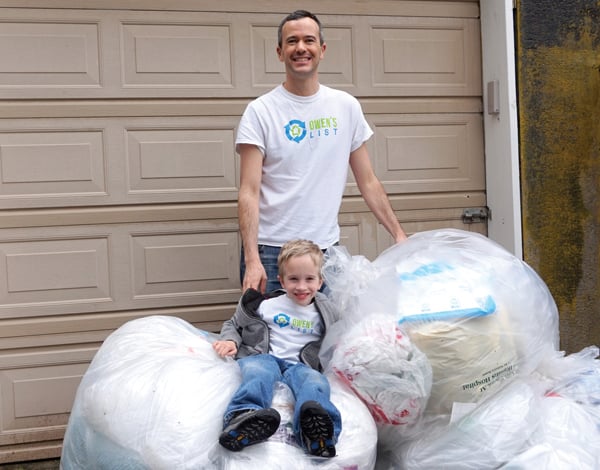 |
Ridwell co-founder and CEO Ryan Metzger with his son Owen.
(Photo courtesy of Ridwell.)
|
A First Look: Recycling Plastic Food Packaging (Even Styrofoam) With Ridwell
BY TILDE HERRERA
|
We ask for a lot from food packaging. It needs to look good and keep perishable food safe, intact, and unblemished as it travels from the producer to grocery stores and then on to people's homes, with minimal weight.
Some food packaging is made of multiple layers of different materials fused together. While this increases durability, it also makes it difficult to recycle.
“We've done a great job as a society of creating packaging that is efficient and appealing,” said Gerrine Pan, vice president of partnerships at Ridwell, a Seattle-based startup that helps consumers send less waste to landfills. “But our rate of packaging innovation has far outpaced our rate of being able to handle that material in the traditional waste management system.”
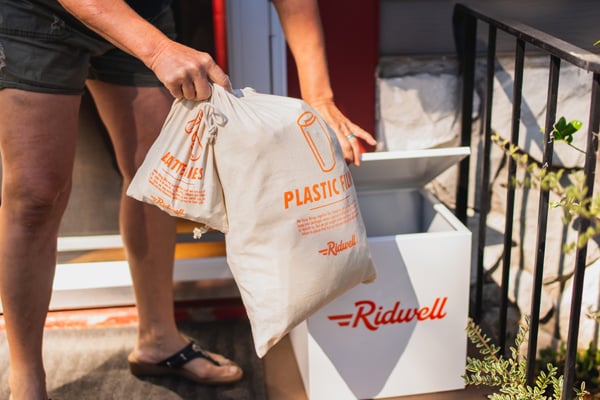
Launched in 2018, Ridwell collects materials that many traditional municipal recycling services won't—such as multi-layer plastic food packaging, plastic clamshell containers, batteries, and lightbulbs—while also educating consumers about how they can reduce waste. Every two weeks, Ridwell picks up the materials from the doorsteps of its members, who pay $14 and up per month.
The company now has 100,000 members in eight metro areas in seven states. It was launched by a Seattle father and son who needed to recycle old batteries, but their garbage company wouldn’t accept them. After calling around and finding a location that would take the old batteries, they offered to take along their neighbors' dead batteries too as part of a “recycling carpool.” It turned into an ongoing weekend project with different materials collected and recycled every week, including electronics and Styrofoam.
Their list of participating neighbors, which became known as “Owen’s List,” eventually topped 2,000, underscoring great demand and confusion about the patchwork of local recycling rules in the U.S., which lacks a modern national standard. In a nation where recycling rules may vary county by county, not to mention state by state, just 32.1 percent of waste is recycled or composted.
Food packaging, in particular, is “ever present, always changing, and very complex,” Pan said. Plastic food packaging is a big problem for traditional recycling systems because they can’t sort flexible plastics such as plastic film and multi-layer plastics, she continued. There is also a high degree of contamination when the wrong materials are commingled in a bin or the materials are dirty. Also, multi-layer plastics often can’t be recycled, because technologies are, unfortunately, largely designed to handle one type of plastic at a time.
"You can neither sort them out, nor can you separate out those layers to get them individually recycled," Pan said.
As a result, the commodity market for plastic film waste is quite small, and even tinier for multi-layer plastic waste, Pan said. Most of it ends up in landfills.
|
|
|
“We're changing consumer behavior one by one and educating communities bit by bit.”
|
|
To date, Ridwell has diverted more than 22 million pounds from the waste stream, including 6.2 million pounds of plastic film such as plastic wrap, Ziplock bags, and bread bags, and 770,000 pounds of multi-layer plastic, predominantly food packaging like chip bags and snack wrappers. How to distinguish between the two? You can stick your finger through plastic film, Pan said, while multi-layer plastic tends to be loud and crinkly.
Ridwell partners with more
than 200 organizations that will reuse or recycle the materials. Hydroblox, for instance, transforms multi-layer plastic into outdoor landscape drainage blocks, and Trex manufactures plastic film into composite lumber for decks and playground sets.
Since Ridwell requires users to sort their own materials, its contamination rate is less than 5 percent, compared to about 15 percent for drop-off grocery bins and at least 30 percent for a municipal blue bin, Pan said. Ridwell gives users detailed instructions on what they can recycle.
“We're changing consumer behavior one by one and educating communities bit by bit,”
Pan said.
That education has been one of the most positive aspects of a Ridwell membership, said Eric Lerner, a community organizer who lives with his family in Alameda, California. His 11-year-old daughter is in charge of sorting.
“It makes us more thoughtful about all the different types of plastic that are used for packaging, which we probably wouldn't think about if we were just dumping it in the garbage every two weeks,” Lerner said. “We get to do an inventory of our plastic garbage when we're sorting it.”
Ridwell also shares educational text messages and case studies. “It's good information and makes you feel like you're part of something bigger than just recycling your own plastic,” Lerner said.
Lerner does worry that
services like Ridwell’s are not accessible for low-income families since they may require a paid subscription. Ridwell's service hasn't made Lerner’s family feel more comfortable buying products in plastic packaging just because they’re able to recycle them. Instead, they’ve become more thoughtful when they shop, bringing their own used plastic bags or cloth bags to the grocery store or farmers’ market.
Beside Ridwell, other specialty recyclers include Rabbit Recycling in the Philadelphia Metropolitan area, the ReCollective in North Carolina’s Research Triangle area, which includes Durham, Raleigh, Chapel Hill, and
Cary, and Recyclops, which serves residents and businesses in more than 30 states.
In addition to innovation and investment in sorting and processing technologies, Pan said policy changes are needed to turn the tide on the plastic waste crisis. She points to California’s Plastic Pollution Prevention and Packaging Producer Responsibility Act, or S.B. 54, as an example. The law, passed in 2022, shifts the burden for plastic recycling to the companies that produce single-use packaging and plastic food service ware.
|
 |
The law aims to boost recycling of single-use plastic packaging and food service ware to 65 percent, trim sales of single-use plastic packaging and food service ware by 25 percent, and ensure that all single-use packaging and plastic food service ware sold in California is recyclable or compostable, all by 2032.
“That’s an example of policy and advocacy that changes the landscape,” Pan said. “It also invites producers to the table to figure out how to manage that.”
In the meantime, she said people can reduce how much food packaging enters their home by buying in bulk, bringing their own bags, using reusables, and avoiding single-use when they can.
“Small actions do add up to big change,” she said. “Every household can make a difference.”
|
(Return to top)
|
|
|
|
|
|
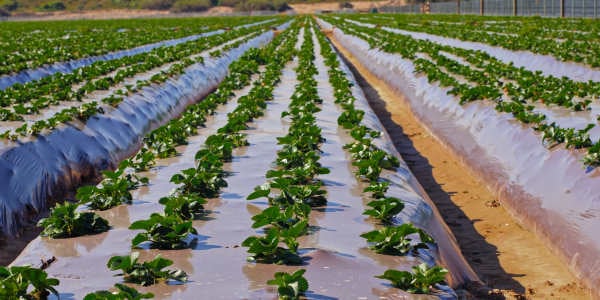 |
Strawberries growing under plastic sheets in California.
|
The Follow-Up: On Farms, ‘Plasticulture’ Persists
BY GREY MORAN
|
In 1948, E.M. Emmert, a horticulturist at the University of Kentucky, was tinkering around with how to build a cheap greenhouse. He decided to use polyethylene sheets in lieu of the glass sides, bending the plastic film around a wooden frame. The plants thrived in the new environment; the plastic let in enough light while trapping in warmth.
This is commonly regarded as the first introduction of plastic into agriculture, a move that would transform modern farming—and inadvertently deposit an untold amount of plastic in the soil.
In the decades that followed, this cheap, pliant material spread through farms across the U.S. and world, becoming so widely used that plastics in agriculture gained its own name: plasticulture.
Today, it’s common to see farms covered in plastic. It lines the sides of greenhouses, blankets fields as “plastic mulch,” covers hoop houses, and winds through farms as irrigation tubes, among other forms. In satellite images, the National Aeronautics and Space Administration (NASA) has observed the typically golden and green agricultural fields turned white, as though dusted in snow, from all of the plastic.
Agriculture is responsible for 3.5 percent of global plastic production, a figure that may seem small until you consider the sheer volume of plastics produced: around 400 million metric tons per year.
Little did Emmert know that this plastic was also degrading over time, breaking down into tiny flakes and accumulating in the soil. Microplastics pervade every part of the Earth, from the bottom of the ocean floor to all forms of drinking water to the human placenta. Complicating matters, plastic doesn’t decompose; instead, it turns into smaller and smaller bits of plastic, eventually becoming invisible nanoplastics. A recent paper called the enormity of tiny plastic litter a “menace to the biosphere.”
“Everything that we create as humans degrades to some degree over time. That’s the reason we’re facing such a massive issue,” said Samuel Cusworth, a research associate at the University of Birmingham, in England, who focuses on microplastics in the soil. “And once they're in the environment, they're very hard to retrieve.”
|
|
“There are currently no viable remediation techniques. If you want to remove them from the soil, [the solution] is to stop producing them in the first place.”
|
The Earth’s soils have become a waste bin of the world’s plastics. Soil is thought to be even more polluted with microplastics than the ocean, which contains an estimated 358 trillion plastic particles. Agricultural soils have been called a “reservoir” for not just the plastic produced on farms, but also plastics from other industrial
sources that enter the water to eventually wash up on farms during a flood, or are carried by the wind. In a world where all industries run on plastics, these fine particles can also find their way onto farms through poultry litter, sewage sludge applied to soils, and even fertilizer.
“There are currently no viable remediation techniques,” said Cusworth. “If you want to remove them from the soil, [the solution] is to stop producing them in the first place.”
The major producers of plastics, like ExxonMobil and Dow, continue to sell plastic to farmers as a way to adapt to extreme weather conditions like drought and flooding. For instance, ExxonMobil promises that plastic sheets, like those used by Emmert, will “protect and preserve harvests in even the most demanding weather conditions.” Yet the production of plastics—a derivative of fossil fuels, typically obtained through fracking—is a major contributor to climate change, responsible for over 5 percent of global emissions.
This creates a vicious cycle, where the production of plastic drives climate change, which drives up demand for plastics on farms. Extreme weather also causes plastics to degrade more quickly, causing microplastic litter. Indeed, a 2021 report from the United Nations’ Food and Agricultural Administration noted that the demand for plastic on farms is projected to grow by 50 percent between 2018 and 2030.
Scientists are still trying to understand how microplastics in the soil impact global food systems and food quality. They do know, however, that microplastics can “greatly change the structure of the soil,” as a review study put it, possibly affecting the cycling of nutrients, the retention of moisture, the storage of carbon, and the overall climate adaptability of a farm.
Nearly every farmer will tell you that healthy soil is the foundation of a healthy farm. And studies have found that microplastic particles in the soil can enter plant tissues—through either the roots or the pores on the leaves—and disrupt the plant’s growth. Plastics can even accumulate in the edible parts of the plant, like its fruits and leaves, potentially threatening food safety.
Cusworth recently conducted the first nationwide assessment of soil microplastics in Europe. He sampled soil from fields of carrots and potatoes across England, comparing farms that utilized plastic sheets to those that hadn’t used these sheets in at least 10 years. He found that all soils sampled contained microplastics, another indicator of agricultural soil serving as a sink for microplastics.
“It was quite shocking to see how high these concentrations are, even without the [recent] use of plastic,” said Cusworth. “That really surprised us.”
Despite the persistent presence of plastics in agriculture, cutting down on their use can still make a substantial difference in the load of plastic in the soil, noted Cusworth. He found that the farms that utilized plastic sheets contained, on average, a staggering 75 percent higher concentration of microplastics in the soil compared to farms without the sheets.
|
“It was shocking to see how high these concentrations are, even without the recent use of plastic. That really surprised us.”
|
Unfortunately, most farmers are not aware of how much plastic is in their soil, because tests are not widely available. “That’s something that I'll hopefully be working on in the next two years—a standardized approach [to microplastic soil sampling],” Cusworth said.
He noted, however, that most of the farmers he worked with in the study were really engaged, giving him hope that ingrained use of plastics on farms can begin to shift. “It would be interesting to see how they may change their practices going forward,” he added.
While there are no remediation methods, farmers may be able to reduce the amount of plastic that enters the soil through “going back to more traditional techniques of farming to work with the environment rather than against it,” said Cusworth. For instance, relying less on tractors and heavy machinery would create “less opportunity for rubber tires to degrade and get into the soil,” he said.
The United Nations’ Food and Agriculture Organization also recommends shifting farming practices to minimize plastics, including replacing plastic irrigation drip tape with a more durable or permanent irrigation system. They advise farmers to return to organic sources of mulch or cover cropping to replace plastic mulch, the plastic sheets placed directly on the soil to suppress weeds and retain moisture. They also recommend a return to glass greenhouses, while launching incentive schemes to support these transitions.
There’s also a potential solution in bioplastics, which can break down into organic material. Yet there’s a major catch: It needs to be collected and composted properly. Otherwise, it will wind up in a landfill for perhaps centuries, much like regular plastic.
In general, “we need to use [plastic on farms] more sustainably,” said Cusworth, “making sure that it's not used wastefully, and that it’s collected and processed properly, in the most environmentally friendly way possible.”
|
(Return to top)
|
|
|
|
|
|
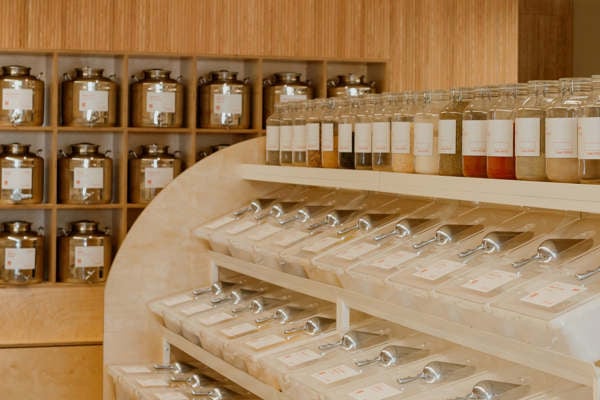 |
Inside a re_ grocery store in the Mar Vista neighborhood of Los Angeles.
(Photo courtesy of re_grocery)
|
The Follow-Up: Zero-waste Grocery Stores in Growth Mode
|
BY CHRISTINA COOKE
|
As a barista in San Francisco for almost a decade starting in 2007, Joseph Macrino hated all of the waste the coffee shop produced—the disposable cups, the lids, the sleeves. He’d give his regulars grief for not bringing in their own mugs.
“I’d be like, ‘Bring your own cup! I see you every day, you get the same drink. I can still do a pretty rosetta or heart on top of your latte, but bring your own cup. It’s such a waste!’” Macrino said.
When he moved to Los Angeles in 2016, he and his then-partner decided to open up the city’s first zero-waste grocery shop. Drawing inspiration from the bulk-food-heavy Rainbow Grocery Co-op, one of their favorite haunts in San Francisco, they opened the doors of re_grocery on Earth Day in 2020.
From neat bins, glass jars, and metal canisters, the certified B-Corp offers more than 500 refillable bulk goods including snacks, seeds and nuts, coffee and tea, oils and vinegars, cereals and grains, household items, and bath and body products. The store purchases its goods in buckets and other containers they can return to the supplier for refill or recycle, and customers can bring in their own containers or cloth bags to stock up, or get reusable containers from the store.
In traditional grocery stores, plastic holds everything from apples to trail mix to detergent to water. “Plastic packaging is ubiquitous,” said Celia Ristow, who launched the zero-waste blog Litterless in 2015. (The site is down now, but will be back up this summer, she said.) “It’s cheap, it’s lightweight, if you need to ship, it’s non-breakable. So, there are some real advantages that you have to
overcome.”
Yet given some of the shocking statistics—that 95 percent of plastic packaging is disposed of after a single use, that only 9 percent of the plastic ever produced has actually been recycled, and that 72 percent of plastic ends up in landfills or the soil,
air, or water—some are trying to figure out how to sell food in a way that prevents plastic from being produced in the first place.
Since opening the first shop in Highland Park, Macrino has opened two additional re_grocery locations in L.A.—and has diverted 500,000 packaging items from the landfill. He would like to continue expanding, eventually to around 10 stores throughout L.A. and then more beyond that. And while the store currently offers delivery throughout the city and the shipping of non-perishables nationwide, he’s currently working to launch the shipping of bulk items nationwide as well, using compostable, biodegradable packaging.
“I really want to change people’s thinking around grocery shopping, around sustainability, around consumerism, around capitalism, thinking about how we can leverage our goals and principles but still run a profitable company,” Macrino said. “It can be done—we’re doing it. But I want to make it bigger than this.”
The first iteration of minimal packaging in stores was the extensive bulk sections in the hippie food stores of the 1960s and ’70s, said Ristow, who currently works as the certification manager for the Total Resource Use and Efficiency (TRUE) zero-waste certification. TRUE is offered by Green Business Certification Incorporated (GBCI), the same agency that oversees LEED and other green rating systems.
|
“I really want to change people’s thinking around grocery shopping, around sustainability, around consumerism, around capitalism.”
|
The second iteration—stores like Macrino’s, which produce little to no waste at all—have taken hold over the last few years, Ristow said. When she began tracking zero-waste and refillery stores in 2015, there were fewer than 10 in the U.S. “It started to explode over the next five years,” she said.
While California and New York are hotspots for zero-waste grocery stores, Ristow also sees them in more unexpected places, like small towns and rural areas, in states like Ohio and Wisconsin. “As this movement took off, the people who started these stores were ordinary citizens. It wasn't a centralized movement. People said, ‘I think my community needs it,’ and so they began opening them where they lived,” Ristow said.
|
|
|
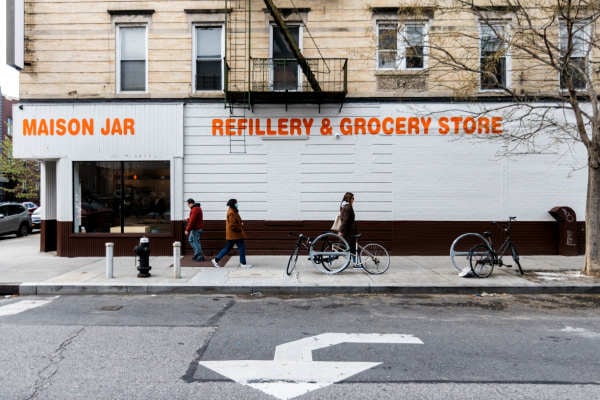
Larasati Vitoux, originally from France, opened the zero-waste grocery store Maison Jar in Greenpoint, Brooklyn, two years ago. European countries are generally at the forefront of efforts to reduce and recycle, and the zero-waste grocery store movement is much more developed there than in the U.S. After visiting her parents in Orléans, France, early in the pandemic, Vitoux noted that their relatively small town, with a population of just over 100,000, supported five zero-waste grocery stores. Meanwhile, in the entire city of New York, with a population of 8.3 million, Vitoux knew of only one, called Precycle.
|
|
 |
Larasati Vitoux.
(Photo by Arnaud Montagard)
|
|
|
She saw an opportunity and started to put together a business plan. Her community—home to many young families—immediately embraced her. Eighty percent of her customers are return shoppers, and most live within a
10- to 15-minute walk. “We opened in March 2022, and by the end of the year, for the holidays, we received a lot of cards from people telling us that we were the best thing that happened to the neighborhood that year,” she said.
The business started making money within six months of opening, Vitoux said, and year-over-year sales increased by 50 percent between the first quarters of 2023 and 2024. Additionally, as of their second anniversary in March, the store had sold—in bulk—the equivalent of 1,420 bottles of olive oil, 1,820 jars of nut butters, 762 plastic-packed blocks of tofu, and 2,443 bottles of kombucha.
|
“We opened in March 2022, and by the end of the year we received a lot of cards from people telling us that we were the best thing that happened to the neighborhood that year.”
|
| In addition to offering local and organic food without packaging, plus perishables like fruit and vegetables, eggs, and bread, Vitoux aims to promote a sense of community around ideas of sustainability. The store has hosted a soap-making workshop, speakers on climate change and eco-anxiety, vendor popups, and happy hours, where all items are 20 percent off for a two-hour stretch. (These are very popular, she said.) Maison Jar is also an electronic waste and battery drop-off location and serves as a pickup location for Green Gooding
, New York’s first circular economy rental system, which offers people access to small appliances like air fryers, juicers, and popcorn makers.
As she continues building her business, Vitoux is working toward a TRUE zero-waste certification offered by GBCI. “It’s a lot of work, but it’s important to have a third-party certifier say you’re doing things the right way,” she said.
There are, however, a number of challenges to operating a zero-waste grocery store.
“I think the hardest part about it is the consumer wants Costco prices from their local mom-and-pop shop,” Macrino said. “For people owning a small business, it’s hard to compete against those humongous companies.” Re_grocery tries to pass on to consumers the savings that comes from sourcing in bulk. “We're really trying to be competitive with our pricing as best as we can,” he said. “But there’s not a lot of options for us to choose from. We really are always looking for other suppliers to give us better competitive pricing.”
|
 |
(Photo by Arnaud Montagard)
|
For Vitoux, New York City rent is very high, and because cleaning and refilling the bulk containers is labor-intensive, she also has to invest a lot in her workforce. Plus, because the number of package-free stores in the U.S. is still relatively small, systemic supports like the ones present in her home country do not exist.
In France, after package-free stores started booming in the early 2010s, she said, the government developed rules and regulations for hygiene and sanitization to govern them. Additionally, a zero-waste business association offers training and support to store owners, and supply chains for bulk products developed because of the increased demand. (The movement’s ideals are taking hold in the mainstream as well, she said: By 2030, the French government is requiring that grocery stores of more than 4,300 square feet devote at least 20 percent of their sales area to bulk items.)
“The trend in Europe, it was really kind of a grassroots-type of growth and then regulation and supply chain followed,” Vitoux said. “I think it could happen here.”
Ristow sees the bulk aisles of traditional grocery stores as a good option for people looking to cut down on waste without access to a full-on zero-waste shop. At the same time, she hopes that as the package-free grocery movement grows, stores will continue to “invest in the idea of being community sustainability hubs” and will also “find ways to welcome in a larger demographic, maybe people who are more price conscious or need to shop with benefits."
Some of the most important work these stores are doing, she said, is developing an alternative model to traditional, plastic-heavy grocery stores. “We have to find alternatives that work before we can scale them,” she said.
Macrino, for his part, is committed to figuring out how to scale. “My goal now is how am I going to get this thing so big that I can get a store in every major city and really make a real impact sustainably?” he said. “I think it can be done. And I think we have the tools to do it.”
Ultimately, he hopes for a cultural shift. “Everyone needs to take a step back and think, ‘These short-term instant gratifications are really piling up, and we really need to rethink how we’re operating.’”
|
|
|
|
|
|
|
What We're Reading
|
How to Reduce Your Exposure to Plastics in Food (and Everywhere Else)
BY LAUREN F. FRIEDMAN, Consumer Reports
It's nearly impossible to completely avoid bisphenols and phthalates. But several small, strategic shifts can help.
California Tried to Ban Plastic Grocery Bags. It Didn’t Work.
BY HIROKO TABUCHI, The New York Times
A ban on single-use bags included an exemption for bags meant to be reused and recycled. Except, they weren’t. New legislation aims to fix that.
The Fraud of Plastic Recycling
BY CENTER FOR CLIMATE INTEGRITY
How Big Oil and the plastics industry deceived the public for decades and caused the plastic waste crisis.
Microplastics and Nanoplastics
BY MARION NESTLE, Food Politics
Microplastics are now everywhere and in everything, including oceans, water supplies, food, animals, and us.
|
|
|
|
|
|
|
That's all for this issue of The Deep Dish. Thank you for reading, and thank you for being a member of the Civil Eats community. If this is your first time reading The Deep Dish (welcome!), be sure to check out our previous issues:
If someone forwarded this email to you, please support our work and become a member today. Questions? Compliments? Suggestions? We love to hear from our members: Please send us a note at members@civileats.com. |
(Return to top)
|
Did you enjoy this newsletter? Help us out by forwarding it to a friend or sharing it on Facebook and Twitter.
|
|
|
|
|
|
|
|
|


