|
|
|
|
The Deep Dish
An insider look at food and farming from Civil Eats
Issue 38, March 2026: AI and Farming |
|
|
 |
|
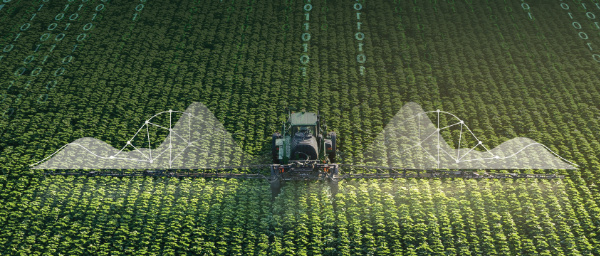
(Photo courtesy of iPES-FOOD)
|
|
|
|
|
|
In this issue of the Deep Dish, we take a close look at the growing issues surrounding the use of AI in farming, both of land crops and seafood. Given the rapid development of AI data centers on farmland and the employment of AI on large-scale farms, we examine who benefits from these high-tech farms and what impacts they have on the food system and those working within it. And we ask: What other solutions exist?
We kick off with an op-ed that provides an overview of the AI “revolution” in farming and seafood, reveals its weaknesses—and argues that regional food systems are the proven and better way to feed ourselves. Our story about a tiny community that blocked a data center from usurping its land offers a model that could help other groups trying to do the same thing. Farmers signing up for ag-tech services can waive the rights to their data without fully knowing it, and our feature on that subject points out what happens to “small data in big hands.”
Lastly, we explore the relatively new field of AI in aquaculture as it tackles the myriad problems rife in that industry, from disease to pollution. Success, we learn, could be a double-edged sword that produces healthier fish but leads to larger farms—and outcomes that no one can quite yet predict.
Thank you for reading, and for supporting Civil Eats as we probe this juggernaut that’s transforming our food system. Look for more of our reporting on AI and food and farming in the months to come.
~ The Civil Eats Editors |
|
|
|
|
|
Please Share and Support
|
|
At Civil Eats, we believe this reporting is too important, too timely, and too consequential to limit who can read it.
Since 2021, The Deep Dish, our award-winning newsletter, has been a way for us to offer our supporters an early, exclusive look at our reporting on food and farming at the moments that matter most, and this issue on AI and farming is one of those moments.
As AI rapidly reshapes land, labor, data, and power across the food system, we hope you will share this issue widely with your friends, colleagues and communities, and encourage them to support Civil Eats so we can continue producing rigorous, independent journalism on the issues that matter most. |
| Donate today! |
|
|
|
|
|
Member Updates |
|
Marion Nestle Talks With the Civil Eats Book Club
Last month, Membership Manager Kalisha Bass led a virtual book club with Marion Nestle to discuss her authoritative tome, What to Eat Now: The Indispensable Guide to Good Food, How to Find It, and Why It Matters, an editors’ pick from our 2025 holiday book guide.
Nestle, one of the country’s most influential experts on food policy and public health (and a Civil Eats advisor), shared behind-the-scenes insights from her book and answered questions from the audience, including about the prioritization of meat in the new Dietary Guidelines for Americans.
We’ll announce the next Civil Eats Book Club soon. In the meantime, login to our Members Hub to watch a video of our conversation with Nestle. Our hub also has videos of our Civil Eats salons, the Deep Dish archive, and other resources. |
| Watch the recording |
|
AI and the Food System Virtual Meetup
We’re hosting a virtual meetup for members on Wednesday, March 18 at 1 p.m. PT/4 p.m. ET to take on a topic that springboards from this Deep Dish: AI and the Food System. Come ready to ask questions and share resources, or just listen if you like. To make our time together valuable and so everyone has a chance to participate, we’re capping these calls to the first 20 people who sign up. (To encourage open and free-flowing conversation, these calls will be off the record and not recorded.)
|
| Sign me up! |
|
What’s Happening in the Members’ Slack Community
The Civil Eats Slack Community is a virtual space for food-system changemakers, policymakers, and practitioners to exchange knowledge and get to know one another. Our team also shares updates on their work inside and outside our virtual newsroom.
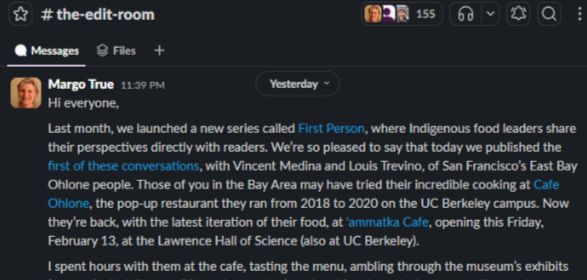
In February, Features Editor Margo True wrote about the editing process and what happens when you have too much good material. |
 |
|
Join the Slack community to check out the rest of Margo’s post, hear more behind-the-scenes coverage, share resources, and chat with other Civil Eats members! Please review these Community Rules and Agreements and accept this invitation link, which is good through March 23. (Here are the instructions if you’re using it for the first time.) |
|
Join Us in Chicago This Month!
Since December 2024, we've been hosting in-person meetups around the country as a way to connect our readers with our team and to learn more about the food-system issues impacting their regions.
Our next in-person meetup will be in Chicago on Tuesday, March 31. If you are in the area and interested in joining, email us for more information. As we continue to do more in-person meetups, help us learn more about where you are located, by filling out this very short survey!
|
| Come hang out with us! |
|
(Return to top) |
|
|
|
|
|
|
|
|
Big tech’s influence on the current federal administration is undeniable. During his first term, President Donald Trump issued an executive order to promote AI research and development. Shortly after taking office last January, he issued another order to investigate and remove any barriers to AI adoption. The One Big Beautiful Bill Act (OBBBA), which Trump signed into law in July 2025, authorizes more than $1 billion in federal funding for AI projects.
The intrusion of AI has spread to our food systems. In agriculture, an AI revolution is being widely promoted by those who stand to benefit: transnational corporations, banks, big NGOs, and governing bodies. Even though there are only 20 autonomous tractors in the U.S. as of 2025, John Deere has plans to go fully driverless by 2030. In seafood, Big Tech is also helping drive the push to expand offshore fish farming. This Blue Revolution—fashioned after the Green Revolution that industrialized agriculture in the 1950s and 1960s—describes the dramatic growth of farmed seafood since the 2000s.
Proponents claim this shift will make production more efficient and help feed the world. But as with previous food “revolutions,” we must investigate these claims.
Farmers today are being told that AI will future-proof their operations, boosting yields and streamlining their work. But in practice, many are signing away their data rights via complex “click-to-agree” contracts, feeding data into platforms they do not control. The tech firms behind these tools then sell the data to seed suppliers, animal and fish feed conglomerates, and pharmaceutical companies, which in turn sell their products right back to the farmers. |
|
|
|
“Farmers today are being told that AI will future-proof their operations, but in practice, many are signing away their rights.” |
|
|
|
TidalX AI, a subsidiary of Google’s parent company, Alphabet, is among the main groups lobbying the U.S. government to, for the first time, open federal waters to large-scale fish farming. The use of underwater cameras and AI underpins efforts to move operations farther offshore, even though doing so can increase risks and reduce the chances of spotting problems early. Last year, researchers reported more frequent and larger mass die-offs on salmon farms, partly due to reliance on technologies that attempt to “optimize” production in riskier environments.
While industrial aquaculture is often promoted as a source of new jobs, both aquaculture and agriculture face the likelihood that AI will replace workers with drones, automated feeders, and ground sensors to determine how much pesticide to apply, when, and where. The “fully autonomous farm” is coming into focus. This foreshadowing, along with continuing mass arrests of farm workers, begs the question: Will robots feed us when workers are deported?
To investigate whether AI will help feed people, we can look to previous tech shifts. It’s true that some tools have increased yields. Feed-measuring and herd-monitoring tools have boosted output per cow on dairy farms. New pesticides and precision methods have raised yields gradually and persistently for decades for soy and corn.
But higher yields have not guaranteed better access to nutritious food. The Green Revolution, for instance, made many farmers in the Global South dependent on synthetic chemicals that produce food of declining nutritional quality while contaminating ecosystems and posing dangers to human health. Moreover, traditional small-scale producers operating without AI have, by some estimates, managed to feed as much as 70 percent of our global population—even though they operate on as little as 25 percent of the world's land.
|
|
“To investigate whether AI will help feed people, we can look to previous tech shifts. It’s true that some tools have increased yields, but higher yields have not guaranteed better access to nutritious food.” |
|
The HEAL Food Alliance, a multi-sector, multi-racial coalition working to transform food systems, recently released a report on “precision” tech and AI tools in food systems. The report identifies a clear pattern: Corporations market these technologies as serving the public good, including as a climate solution. In reality, they consolidate corporate power and shift environmental costs onto communities and ecosystems. This diverts resources away from the farmer- and fisher-led solutions that keep ecosystems intact, support local economies, and strengthen food sovereignty. Food systems dominated by a handful of corporations are inherently vulnerable and unsustainable. Moreover, the data centers that power AI gobble up farmland and water, making it even harder for younger people to get into the profession.
We know that, as countries grow wealthier, the demand for meat and seafood rises. So the question remains: Will ramping up production in both agriculture and aquaculture improve food security—or simply expand the supply for premium markets and exports?
Here at home, as high-tech food production has increased, our food system has become more, not less, dependent on global trade. The U.S. imports about half of our fruit and one third of our vegetables. Seafood shows this dynamic even more clearly: American fishermen land more than enough wild seafood to meet domestic demand, but much of it is exported, while lower-quality imports are brought back.
|
|
This system does not feed people here or support the livelihoods of our food producers. It feeds global commodity markets, allowing corporations to move food wherever it fetches the highest return. The vulnerabilities of our globalized food system have surfaced repeatedly, including during the early stages of COVID-19, when farmers plowed their crops under and fishermen had no market for their catch. Just this year, retaliatory tariffs in Trump’s trade wars have further exposed our dependence on unstable global markets.
We know there are better solutions for feeding people, namely investing in local fisheries, small farms, and food systems at home that provide high-quality food while honoring ecological responsibility, fair pricing, and equitable access.
In this spirit, and challenging the various ag provisions in the OBBBA, more than 500 farmer and consumer groups have called for the “skinny farm bill” to include initiatives to restore SNAP funding, improve credit and land access, and make markets more competitive. As Congress revisits the Farm Bill, lawmakers should renew funding for Farm to School and Local Agriculture Market Programs, which directly support the food producers in our communities.
Similarly, Congress should reintroduce the Domestic Seafood Production Act (DSPA), which would improve working waterfront infrastructure, local processing, and training initiatives for seafood workers. Earlier this year, a subset of DSPA, known as the Keep Finfish Free Act (KFFA), was introduced. Passing KFFA would bar federal agencies from authorizing large-scale finfish farms offshore without an act of Congress.
We need to keep a vigilant eye on each wave of tech change, asking whether it will actually feed people who grow and catch our food. Technology isn’t the enemy—until it’s monopolized and weaponized by corporations. Without guardrails, AI risks accelerating the extraction and exploitation already decimating our food systems. |
|
|
|
|
|
 |
|
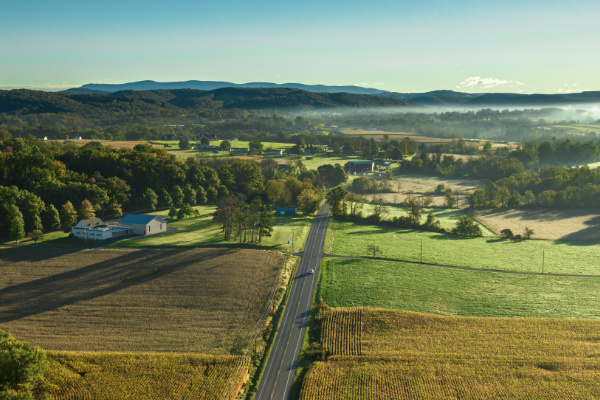
Central Pennsylvania farm country. (Photo credit: Getty Images) |
|
|
How a Tiny Farm County Fought a Data Center Complex and Won |
|
BY BEN SEAL |
|
|
|
On a bright day in early February, farmers Mark Shultz and Mike Leighow drove along the ruler-straight roads of Montour County in north-central Pennsylvania. From Shultz’s new Chevy Silverado, they gazed at the snow-covered farmland with a sense of nostalgia. These fields were at the heart of a proposal to rezone more than 800 agricultural acres to make way for a data center that residents had been fighting for months. Shultz and Leighow were just two out of hundreds of opponents.
Shultz slowed the truck as they passed the area where residents expected the data center would go, just a short distance from Talen Energy’s Washingtonville natural gas power plant. The company aimed to partner with Amazon Web Services for a data center buildout that would kick farmers off the land they leased from Talen and further reduce the county’s dwindling farmland. Even though the rezoning hadn’t yet been approved, workers dotted the open fields, surveying them for the anticipated development.
As tech companies and developers seek to power the artificial intelligence boom by building data centers anywhere they can, farmland is increasingly in high demand. The surge is sparking backlash in places like Montour County, where the loss of farmland, spiking property values, and a suite of environmental concerns threaten to destabilize agricultural communities.
Talen had already recently sold a nuclear-powered data center to Amazon in Berwick, about 20 miles from the proposed site in Montour County, and Amazon was expanding that complex to 960 megawatts—equivalent to the annual energy consumption of nearly one-fifth of all Pennsylvania households. This was the fate Shultz, Leighow, and their neighbors feared for their community.
But just a few days later, Montour County commissioners unanimously rejected the rezoning request. Sam Burleigh, a co-founder of Concerned Citizens of Montour County, a community action group formed to fight the proposal, called it a “David and Goliath” moment. |
|
|
|
“Public participation matters—and it has mattered here.” |
|
|
|
As data centers proliferate, the response in Montour County shows what it might take to stem the tide. Commissioner Rebecca Dressler cited "extraordinary public engagement” in voting against Talen’s request, which she said failed to demonstrate a clear public benefit.
“Public participation matters,” she said, “and it has mattered here.”
An Ideal Base for Data Centers
Pennsylvania is already home to more than 50 data centers of various sizes, and at least 50 more have been proposed. Ginny Marcille-Kerslake, a senior organizer with Food & Water Watch who supported the community’s resistance in Montour County, says the state has become a hotbed because of its abundant power, water, and land—the three essentials for data center development.
Pennsylvania is the country’s third-highest producer of energy, needed in enormous quantities to power data centers. It offers the largest network of waterways in the contiguous United States, necessary for cooling down the thousands of computers inside data centers. And it boasts millions of acres of relatively flat and open agricultural land that is ideal for development, if it can be secured.
The state’s Democratic governor, Josh Shapiro, a presumed 2028 presidential candidate, has also welcomed the influx, promoting Amazon’s proposed $20 billion investment in the state by signing into law a tax break on purchases of key data center equipment.
Farmers Face Disruption
For farmers in Montour County and beyond, the data-center boom threatens to shrink farmland and reduce the productivity of what remains.
Multiple sources, including Shultz and Leighow, say that if Talen had succeeded in its bid, it would have also removed from agriculture additional neighboring land that it purchased contingent on getting its own land rezoned. Already, Montour County—at 132 square miles, the state’s geographically smallest county—has watched its farmland steadily disappear, losing 22 percent of its land and 28 percent of its farms between 2017 and 2022 alone. The rezoning would have exacerbated that trend.
|
|
|
 |
|
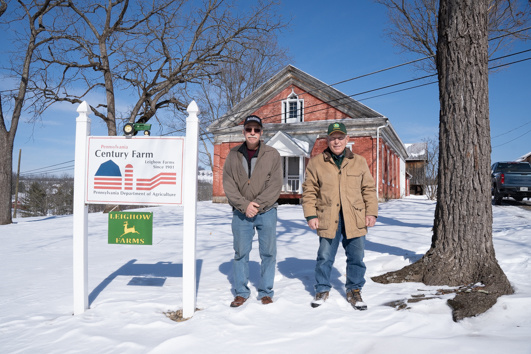
Mark Shultz, left, and Mike Leighow outside Leighow's Century Farm.
(Photo credit: Ben Seal)
|
|
|
|
Andy Bater, a Pennsylvania Farm Bureau board member, says the disappearance of farmland can lead to “a vicious cycle” of increased prices that push out current farmers and keep away new entrants. “That’s the dilemma that I think about all the time,” he says.
What’s more, nearby farmers would be forced to reckon with operating alongside a data center. Shultz has already gotten a taste of the risks, due to transmission lines that run to and from the Talen plant in Washingtonville, cleaving his 500 acres of corn, soy, and hay. The energy company tramples his crops to access the lines, and he worries about the effects of stray voltage. Talen has been “an unfriendly neighbor” for years, he says; residents still lament the destruction of Strawberry Ridge, a farming village that was razed to make way for the power plant decades ago.
Data centers have prompted a litany of community environmental complaints, including for their massive draw on local water supplies—a particular concern in Montour County, where the vast majority of residents and farms rely on wells.
“If we can’t get water, we can’t survive,” says Leighow, who grows 105 acres of corn and soy in Montour County on land first purchased by his grandfather in 1901.
The round-the-clock noise and light that data centers produce can also stress animals and inhibit dairy production. Their incredible need for electricity risks disruptions to the grid that Shultz and Leighow worry would affect their own needs, and it drives up electricity bills in the community overall.
The Community Stands Up
By the time Montour County residents learned about the rezoning bid last summer, many feared it was already too late. They heard about Talen’s plans not from the company, but through word of mouth as neighbors began receiving offers to buy their land at six to seven times the market rate. Residents formed the Concerned Citizens group. Through right-to-know requests, they discovered that a data center complex was the ultimate goal of the rezoning bid and quickly rallied behind an effort to quash it. |
|
|
 |
|
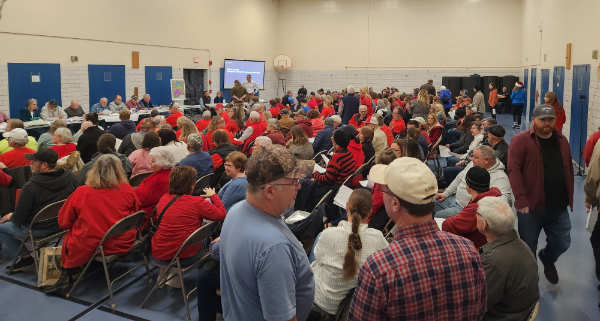
Residents attend Montour County Planning Commission meeting in November, when the data center proposal was discussed. (Photo credit: Sam Burleigh) |
|
|
|
“I don’t want to be treated like a mushroom, kept in the dark and fed bullshit,” Leighow says.
In the months before the county commissioners’ vote, residents showed up by the hundreds to town halls and a public hearing on the request, carrying signs and wearing red T-shirts imploring “Say No!” to industrial rezoning. More people signed a petition against the proposal than voted in the 2024 election.
Residents were motivated to fight after witnessing what had befallen neighboring Berwick, where the community learned about the construction of the data center too late to do anything about it. “[It] lit a fire for us, seeing how they got railroaded,” Burleigh says.
The fight in Montour County is “a shining example of what a community can do and how to do it,” Marcille-Kerslake says.
The battle may not be over yet. Talen did not respond to requests for comment but has reportedly indicated it intends to continue pursuing a path forward in Montour County. People in surrounding communities are now being approached for land that could serve as an alternative location, Marcille-Kerslake says.
‘We Spoke With One Voice’
For Marcille-Kerslake, the vote in Montour County offers a reminder that opposition to data centers is most powerful at the local level. Food & Water Watch encourages municipalities across Pennsylvania to pass zoning ordinances to prevent development before it gets off the ground, particularly in agricultural areas where data centers are incompatible with farmers’ needs. |
|
|
|
“These communities know firsthand that what they have is worth protecting. They cherish that land. They cherish their agricultural lifestyle and community, and what they are producing is the very thing that we depend on.” |
|
|
|
“These communities know firsthand that what they have is worth protecting. They cherish that land. They cherish their agricultural lifestyle and community, and what they are producing is the very thing that we depend on,” she says. “What this victory shows them is that it is possible to keep protecting it even when faced with these extremely wealthy and powerful corporations. They really just need to work together and use their voices at the local level.”
Burleigh has heard from communities across the country facing their own data center proposals, including groups from Texas, Oklahoma, California, and Maine, among others. Montour County’s rejected rezoning, he says, “gives a breath of hope to all the municipalities that are battling this.”
Shultz wants others to learn from what his community has accomplished. “Don’t lay down and let them roll over you,” he says.
Leighow adds: “We stood up as a community and were clear about our values. And we spoke with one voice.” |
|
|
|
|
|
 |
|
(Photo credit: Jed Owen, Unsplash) |
A Hidden Crop for Corporate Tech: Farm Data |
|
BY ELSA WENZEL
|
|
|
|
Andrew Nelson is a self-described “tech-forward” farmer near Garfield, a tiny town in eastern Washington close to the Idaho border. He uses popular precision agriculture services, paired with artificial intelligence, to produce wheat, canola, lentils, garbanzos, and green peas across 7,500 acres.
Precision farming technologies gather data from a variety of points, such as GPS coordinates from tractors, seeding rates from planters, pesticide volumes from sprayers, moisture readings from soil probes, and yield estimates from combines.
The services—from Bayer, Deere, Corteva, Trimble, and others in the ag-tech sector—increasingly use artificial intelligence to detect patterns, weaving together farmers' data with other feeds, like satellite images and weather station readings. Farmers can open dashboards on their smartphones or computers to see overviews of conditions and trends, along with suggestions about practices to tweak.
Nelson takes advantage of many of these capabilities, feeding his spraying data to Bayer Climate FieldView to receive recommendations on chemical applications. He allows John Deere Operations Center to collect data from his tractors and combines to provide him insights on equipment performance and efficiency.
But the fifth-generation grower doesn't share all his field-level data with the services. “I've read the terms and conditions,” says Nelson. “But giving some of that information to the person that I'm having to buy a three-quarter of a million-dollar machine from just doesn't sit quite right.”
Ads for these AI-powered services promise to “empower” farmers to “harness” their data and “make better decisions,” boosting yields and unearthing efficiencies. In the U.S., uptake is relatively high, with 27 percent of farms or ranches using the tools, according to the U.S. Government Accountability Office. And market analysts project double-digit growth for these tools, expecting them to reach as high as $27 billion by 2030 worldwide. Aiding the growth are multiple tailwinds, including incentives bundled in the latest draft of the U.S. farm bill. |
|
“Giving some of that information to the person that I'm having to buy a three-quarter of a million-dollar machine from just doesn't sit quite right.” |
|
With the industry poised to expand exponentially over the next few years, small-scale farmers and sustainability advocates worry that big companies will leverage their data to sell more products and services, corner markets, or even threaten their livelihoods.
‘Small’ Data in Big Hands
While 70 percent of precision ag-tech users globally are large operators, smaller farms are slower to buy in.
California almond grower Rebekka Siemens has resisted sales pitches for expensive “smart” irrigation systems. “On the one hand, it's attractive that the reporting can be integrated or exported for reporting purposes easily,” says Siemens. “On the other hand, it could harm you. . . . It feels exposing, the lack of privacy. We don't know who's doing what with it.”
There may be little value in “small” data from more modest plots of land, but corporations see aggregated pools of information as a gold mine. And training AI systems on the capture of feeds from thousands of farms raises questions of who should hold the intellectual-property rights.
|
|
“It's essentially like we're being charged to use the service and then the company is making even more money off of us by selling our data,” Siemens says.
Most ag-tech services insist that they are granting farmers ownership of their data. “Farmers own their own data—full stop,” said Brian Leake, a spokesperson for Bayer, pointing out that the Climate FieldView technology has been certified by the auditing nonprofit Ag Data Transparent since 2021. “They can choose to share their data with others and request that their individual farm data is deleted.”
Watchdog groups warn, however, that legalese within click-to-sign contracts favors the businesses. Surprises can lurk within a 10,000-word software license agreement, they say. And a contract that prevents a tech company from selling data to a third party may nevertheless grant a business partner broad rights to exploit and share anonymized pools of data.
A gray zone exists regarding who controls the bits and bytes, which the ag-tech providers store with the likes of Amazon Web Services, Microsoft Azure, and Google Cloud.
Advocates also raise red flags about the perceived marriage between Big Tech, which profits from people’s data, and the Big Ag companies blamed for industrializing agriculture and squeezing out family farms.
The fears are manifold. What if the main purpose of collecting all this data isn't to help farmers, but to sell more products? Where does data go if a startup folds? What if a bad foreign actor uses intelligence to disrupt the food system? Could government use evidence of fertilizer use today to punish a farm later for nitrogen pollution? What if the data lands with hedge funds or investors who manipulate commodity markets or drive down land prices to further concentrate land ownership?
Elizabeth Vaughan, senior manager of the Small-Farm Tech Hub at the Community Alliance with Family Farmers, worries that AI might further concentrate power outside farmers' hands.
“Is Amazon going to be our food producer 50 years from now, or Microsoft—or are we still going to have small farmers that provide for their local communities, grow culturally relevant crops, and have resilient community food systems?” she asks. |
 |
|
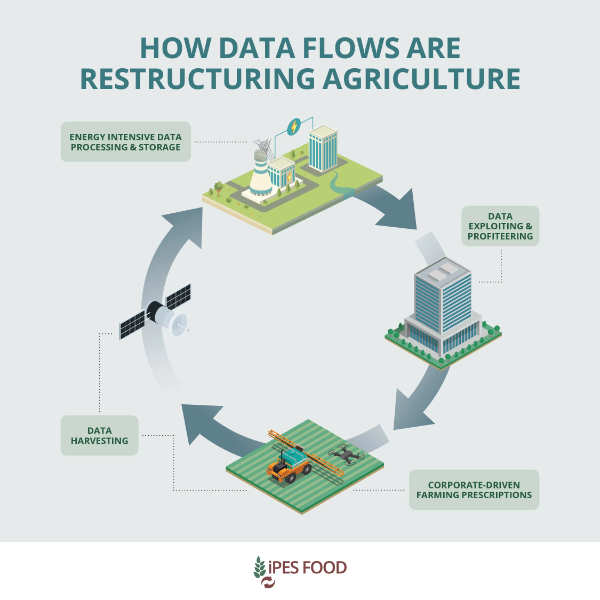
This infographic, courtesy of IPES-FOOD, shows the flow of farm data into corporate control. (Click for a larger version.) |
|
Related suspicions led Bayer to drop a planned partnership with startup Tillable, often described as an “AirBnb for farmland,” in February 2020, four months after it was announced. When Tillable sent unsolicited cash rental offers to farm owners, farmers accused it of crafting its bids using data about farm yields gleaned from Bayer's Climate FieldView. Bayer, however, said it did not establish any backend data-sharing with the startup.
Protections and Alternatives
Federal regulations have not caught up with the rapidly developing AI and machine-learning tools that harvest masses of data. Tech companies have lobbied against bills they say would hamper innovation. And members of Congress overwhelmingly agreed to remove a proposal from the One Big Beautiful Bill Act, passed in July 2025, which would have barred states from making new laws regulating AI for up to a decade.
However, state lawmakers are acting.
In Nebraska, the Agriculture Data Privacy Act (LB525) is the first bill anywhere claiming privacy rights for business data, according to attorney Reed Freeman, a partner with ArentFox Schiff who specializes in data privacy and security. The latest version, watered down since it debuted in 2025, would bar third-party companies from monetizing farm data without the farmer's permission.
If the bill becomes law, it could have broad business implications beyond agriculture, according to Freeman. “This is saying there's value in non-personal data, and . . . the guy who generated it is the guy who should wrest the value out of it,” he says.
Meanwhile, a handful of coders, farmers, and educators are looking to enable small-scale farmers to benefit from data-driven insights without having to surrender their information to big tech companies.
“It's important for you to control this data, but there's no value in it if you just put it on a hard drive on your desk and never do anything with it,” says Ben Craker, who grows corn, soybeans, wheat, and hay in central Wisconsin. Craker serves as president of the Ag Data Coalition, a nonprofit that allows farmers to retain, share, or restrict access to their farm data while choosing to enable universities to use it for research purposes.
Other digital tools are emerging that sidestep the corporate giants. For instance, farmers and researchers at the University of British Columbia created open-source LiteFarm software to help farmers with crop planning and tracking tasks.
And Washington grower Nelson is working on a low-cost service, Ag Answers, which would use AI-based text chats to help farmers gain insights from their fields, fill out USDA forms, and suggest when equipment may be overdue for maintenance.
Beyond the Data
Advocates of sustainable farming practices want more for farmers than just retaining data sovereignty, however. They feel that most ag-tech tools do not adequately serve small-scale, diversified farms and are concerned that high-tech services prioritize maximizing yields of monoculture crops over soil health and climate resilience. |
|
They also doubt the ag-tech claim that precision agriculture is environmentally beneficial—a way to decrease the use of fossil-fuel-heavy pesticides and fertilizers—a point bolstered by a new HEAL Food Alliance report that shows that the use of fertilizers and pesticides have actually climbed alongside the rise of precision agriculture.
In addition to making farmers dependent on proprietary corporate offerings with questionable data protections, digital technologies remove farmers from the land, says soil scientist Jessica Chiartas, who serves as board president for RegenScore, a tool that collects data on regenerative farming practices. “The best way to manage your farm is to be out there on the ground, looking, smelling,” she says.
Nettie Wiebe, a professor, farmer, and longtime farm activist in Saskatchewan, contributed to a February report by the International Panel of Experts on Sustainable Food Systems (IPES) that challenged the “false promise” of digital agriculture. Industrial agriculture is concerned mostly with mechanical innovation, she says, and is “premised on a view that the natural world is just made up of many, many, many data points.”
She holds a different view: “Those of us who farm in a small-scale way, we know that actually it's [about] the interrelationship between various organic elements that make up the natural world.” |
|
|
|
|
|
 |
|
ReelData AI vision technology in action. (Photo credit: ReelData) |
Will AI Help Solve Aquaculture’s Problems? |
|
BY MEG WILCOX |
|
|
|
Finfish aquaculture, particularly in the oceans, faces a slew of challenges, including disease outbreaks, high mortality rates, water pollution, fish escapes, and feed problems. AI systems are being introduced to tackle these issues, but the solutions are newly emerging and not yet widely adopted.
Some AI models try to predict disease outbreaks or track when nets need repairing. Some are also programmed to act without human input—for example, administering laser energy to kill sea lice, a major problem in the salmon industry. Most, however, focus on improving feed efficiencies, since feed averages 60 percent of a fish farm’s costs. The models often combine computer vision, which gives cameras the ability to detect and analyze images just as a human would, with machine learning, which enables machines to learn from data and improve over time without further programming.
More than 90 companies are developing AI tools for aquaculture, with the majority headquartered in Norway or the United States, according to new research by ReThink Priorities, a think and do tank. Seventy-six percent of the innovations focus on finfish, especially high-value species like salmon but also trout and tilapia. Most systems are used by large industrial fish farms. That is changing, though, as AI companies develop business models to accommodate smaller-scale operators.
The jury is still out, however, on whether AI applications can help the industry address its most pressing problems. And there are concerns, as in other sectors being transformed by AI, about data quality and privacy, high costs, and the impacts on labor.
Where Is AI Deployed in Aquaculture?
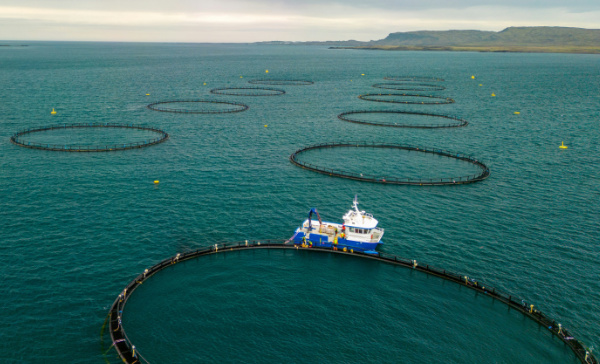
Thus far, AI adoption worldwide is concentrated among a small number of large companies. Eric Enno Tamm, CEO and co-founder of British Columbia–based seafood software company ThisFish, estimated that in 2024, the seafood industry invested more than $610 million on AI-related initiatives—and that 10 of the world‘s largest aquaculture companies had made 86 percent of those investments. |
 |
|
(Photo credit: Ed Wingate, Unsplash) |
|
Many of these companies are in Chile or Norway. The latter is the epicenter for this type of AI innovation, with its super-size farms and their data-rich environment attracting AI entrepreneurs.
In the U.S., which has less than 1 percent of the world’s aquaculture, a small number of companies are using AI. Cooke Aquaculture, which produces at least 13,000 metric tons of salmon annually in Maine’s coastal waters, and Atlantic Sapphire, a land-based system in southern Florida that produced 5,096 metric tons of salmon last year, for instance, use AI systems to monitor their stock and optimize feed. Blue Ocean Mariculture, a smaller Hawaiian farm raising kanpachi (Seriola rivoliana), is experimenting with AI to measure fish weight, inventory, and behavior.
Blue Ocean Mariculture also collaborates with the National Oceanographic and Atmospheric Administration (NOAA) on a project using computer vision to monitor and evaluate the behavior of endangered Hawaiian monk seals frequenting the farm. After a baseline study showed where the seals were pulling fish from the pens, the company made equipment changes. This included smaller mesh sizes, a new nursery pen designed for juveniles, and a “mortality trap” with a slide and one-way door that collects and seals off dead fish from predators, Tyler Korte, Blue Ocean’s vice president of marine operations, told Civil Eats.
AI Tools for Feeding Fish
Most of the current AI innovation in aquaculture focuses on efficiencies in feeding. Unlike land farmers, fish farmers cannot see their animals to monitor their appetite levels or health status. They estimate how much feed to give thousands to millions of animals by netting out and manually weighing a few hundred fish from each pen or tank every month and working up an average, which they then apply to their total stock. |
|
“What we’re seeing, based on data, is a lot of overfeeding.” |
|
“There’s a lot of error that goes in with that sampling bias,” said Mathew Zimola, founder of ReelData, an AI company. He added, “farmers don’t want to touch their fish because it stresses them out.”
ReelData uses hardware and software systems that enable land-based aquaculture farmers to monitor their fish biomass and automate feeding, without having to scoop them from the water. Its systems deploy underwater cameras equipped with computer vision—a gamechanger for monitoring fish populations on farms and in the wild—to measure and analyze fish in a tank as they swim past.
AI tools for optimizing feed are also gaining traction in the shrimp industry, said Dominique Bureau, professor of Animal Nutrition and Aquaculture at the University of Guelph in Canada. These systems use an AI-enabled, underwater microphone, developed by AQ1, that listens for the clicking sound that shrimp make when they bite. Using machine learning, these tools can predict when the animals need to be fed.
“What we’re seeing, based on data, is a lot of overfeeding,” Bureau said. Excess food, he explained, nourishes potentially pathogenic bacteria in the water that produce toxins harmful to shrimp. “Basically you kill your crop.” Automatic feeders coupled with AI microphones are “a great improvement,” he said.
The U.S. produces a fraction of the world’s farmed shrimp. Most farms are very small, though some may use AI tools for measuring shrimp weight and length, such as those developed by Tomota, said Brian Vinci, director of the nonprofit Conservation Fund’s Freshwater Institute.
Imperfect Solutions
AI applications for aquaculture suffer from broader challenges inherent in these technologies: costliness, data quality, availability, privacy issues, and unproven effectiveness. Job loss is also a concern, though it’s too early to tell what impact these emerging systems may have on labor. |
|
Industry insiders agree that few fish farms have robust enough data-management systems for deploying cost-effective AI tools. Uneven data quality can contribute to glitches.
“One of the problems with AI is, it sometimes gives you unpredictable results that can mess up your system,” said Rackesh Rajan, a research scientist at the Freshwater Institute, who develops AI tools for land-based aquaculture. “There should be a human in the loop who can check and then do the final action.”
Data privacy is also a concern as fish farmers hand over sensitive business and technical data to AI companies, which sometimes anonymize and share their data with feed and pharmaceutical companies and other suppliers to help them hone their products. Regulations are needed to protect data privacy, and farmers need to be clear when they sign agreements with AI companies about how and where their data will be used, Rajan said.
The costs can be a barrier for many farmers. AI’s high price tags have favored adoption by the biggest players. The AI hydrophone, for example, costs tens of thousands of dollars per pond, Bureau said. However, AI companies are now offering aquaculture tools for a monthly service fee, making them more accessible to a wider range of operations. ReelData’s biomass and feed programs cost a couple thousand dollars a month, Zimola said. “Any farm that’s producing at least 300 metric tons of fish a year can get value from our system.” AI-equipped cameras, which can cost a million dollars, can also now be rented.
And performance claims aren’t yet backed by independent data. ReelData’s feed program increases the growth rate for fish by an average of 10 percent, “turning a 1,000-metric-ton farm into a 1,100 metric ton-farm,” Zimola said. The program reduces the feed conversion ratio (the amount of feed going into a system versus the amount of food produced) by about 10 percent. Though he’s confident in those numbers, Zimola said, he “isn’t there yet” with publishing the data.
In fact, no independent studies yet exist to evaluate how these emerging AI systems are improving feed operations, fish health, or water quality. “We’d love to see more peer-reviewed data, as opposed to self-reported data from the companies themselves,” said Sophie Williamson, senior researcher in animal welfare at ReThink Priorities.
A Double-Edged Sword?
While AI-enabled tools may solve some industry challenges, they could also lead to larger farms—and the impacts that come with them. “Detecting earlier disease, improving water quality, reducing overfeeding are all positive things for animals,” said Williamson. But there’s a flip side, she said: “We would expect farms may want to stock more aquatic animals.”
|
|
While AI-enabled tools may solve some industry challenges, they could also lead to larger farms—and the impacts that come with them. |
|
Williamson is particularly concerned that farms may increase stocking densities if AI helps them reduce or better monitor disease, and that could have other animal welfare impacts.
Alternatively, as companies increase efficiencies and reduce costs, they may expand the size of their farms. That is likely true, according to Tony Chen, founder of Manolin Aqua, an AI service that uses machine learning to predict fish health. “When you talk to farmers, they all want to make more money [and] bring more fish to the market, but . . . the piece that created uncertainty in their businesses is fish health.”
The MARA Act, which supports deep-ocean aquaculture research, is moving through Congress. If it passes, the legislation could lead to larger fish farms in U.S. waters, and potentially a wider adoption of AI systems within the industry.
For Vinci, AI tools might help clean up some of the industry’s problems. “I do think we’ll see improvements in things like identifying fish behaviors that show stress, or showing ulcers on fish or lice on fish, and having ways to quickly address that before it gets out of control,” he said.
|
|
|
|
|
|
 |
|
Sarah Zuhlsdorf. (Photo credit: Alex Rosandick) |
Member Spotlight: Sarah Zuhlsdorf Wants to Use Technology to Make Farmers’ Lives Easier |
|
BY TILDE HERRERA |
|
|
|
When the pandemic hit, Sarah Zuhlsdorf saw empty shelves at grocery stores but plenty of fresh produce at her local farmers’ market. Unfortunately, not enough people were buying it because they were afraid to leave their homes.
So, she and her future husband started delivering food from the farmers’ market to her neighbors, using a Google doc as an order form and collecting payments through Venmo. The experience resonated deeply with Zuhlsdorf, a UX designer who had spent several years looking for her place in the food system, including tryouts at restaurants and informational interviews at food-related nonprofits.
"It lit this fire in me to connect more people with local food and use my design and systems-thinking skills to find a new way to do that," said Zuhlsdorf, an upbeat 35-year-old who was raised by a recipe-developer mom in Minneapolis. |
 |
|
Zuhlsdorf at the farmers' market early in the pandemic.
(Photo credit: Alex Rosandick) |
|
Today, the Sunnyvale, California, resident works full-time as a UX designer for Comcast. For several years, at night and on weekends, she’s been pursuing her own projects: interviewing people working in the food system to understand their day-to-day challenges, and then experimenting with digital tools that could make their jobs easier.
For example, she created a web app called August to help people order directly from farmers, but decided against pursuing it. The market wasn’t big enough, and she wanted to help as many farmers as possible. Zuhlsdorf is now developing a tool called Persimn to connect farmers directly to commercial food buyers like schools or restaurants. She's early in the development process, but hopes to launch Persimn in the next few months.
"What I discovered during my conversations . . . is that commercial food buyers tend to spend, like, 30 to 60 percent of their time each week just reaching out to farmers to find what their product availability is," Zuhlsdorf said, summarizing the constant calling, texting, and emailing of farmers for the latest updates—which, of course, takes up farmers’ time too. "We know that those relationships are important . . . but that part of the communication can become easier."
Zuhlsdorf wants to design products that make people’s lives smoother. Her mantra: Find a way.
She earned a degree in industrial design, but was dissatisfied with her first job, designing furniture that was "getting manufactured in China, shipped over to the U.S., sold for low prices, and eventually ending up in a landfill," she said.
As she learned more about larger societal issues such as climate change and social inequities, she pivoted and went back to school to earn an MBA in sustainable management at Presidio Center for Sustainable Solutions.
Zuhlsdorf sees great potential for using technology to help the food system operate better. Based on her discussions with farmers, she believes two of their greatest needs are to save time and find reliable buyers.
"We can use technology to solve those needs by making communication easier," she said, "and by helping farmers and buyers build trust much easier and quicker, too." |
|
|
|
|
|
|
|
|
Tech Firms and AI Farming Tools ‘Playing with the Food System,’ Warns Think Tank
BY KAAMIL AHMED, The Guardian
Google, Microsoft and Amazon among companies using algorithms and AI to influence what crops are grown and how, say critics |
|
The Farming Industry Has Embraced ‘Precision Agriculture’ and AI, but Critics Question Its Environmental Benefits
BY GEORGINA GUSTIN, Inside Climate News
Why have tech heavyweights, including Google and Microsoft, become so deeply integrated in agriculture? And who benefits from their involvement? |
|
How NDAs Keep AI Data Center Details Hidden From Americans
BY NATALIE KAINZ, NBC News
Big Tech companies use secrecy agreements with local governments to keep communities from knowing who is building in their backyards.
|
|
US Farmers Are Rejecting Multimillion-Dollar Data Center Bids for Their Land: ‘I’m Not for Sale’
BY NIAMH ROWE, The Guardian
Families are navigating the tough choice between unimaginable riches and the identity that comes with land. |
|
Beyond the Solar Panel
BY BILL MCKIBBEN, The Crucial Years
“What if the data-center hyperscalers, instead of rushing up expensive and dirty diesel generators, agreed to fund the installation of those heat pumps in a bunch of homes? That would free up huge amounts of now wasted electricity, which we could then use to power this theoretically essential new industry.”
|
|
|
|
|
|
|
That's all for this issue of The Deep Dish. Thank you for reading, and thank you for being a member of the Civil Eats community. If you are a new member and this is your first time reading The Deep Dish (welcome!), be sure to check out our 37 previous issues—covering topics including climate change, plastics, food mutual aid, and much more—by logging into our Member Hub.
|
|
|
|
|
|
|
|
|
|
|