|
|
The Editors' Desk
We know that many of you read and support Civil Eats because of our rigorous reporting on agricultural practices and policies, and not for recipes or restaurant reviews. So you might be surprised that we decided to devote this issue of the Deep Dish to revitalizing home cooking. Here’s why.
We know that you care deeply about the food system, and are also probably just as exhausted as we are in the kitchen. (We asked you about it earlier this year, and you had a lot to share.) So, we enlisted a star-studded group of experts to help address many of our home cooking challenges, and in the process, help remind us that cooking can be a meaningful way to support a good, fair, and just food system.
We spoke to Kim O’Donnel
about her seminal article for us, and why cooking is still the cornerstone of sustainability. (Don’t miss her at our salon tomorrow with Bryant Terry; more details below.) We also went shopping with author and climate consultant Sophie Egan, leveled up our meal prep with cookbook author Nik Sharma, talked to college students who have mastered cooking in small spaces (i.e., dorm rooms), got schooled from San Francisco’s Civic Kitchen about the best ways to preserve and store food, and learned how to love leftovers with writer Tamar Adler. The Civil Eats team, and some of our members, also offer our own tips and tricks for making cooking easy and fun.
This issue comes at an exciting time as we introduce our new Editorial Director Margo True, who officially joins the team this week, and offers her own home cooking advice. For True, it’s all in the planning. “On Friday or Saturday, I take an hour to figure out easy dinners for the coming week, cruising through favorite cookbooks and websites and imagining all the good flavors to come,” she says. “Then I funnel the recipes into one big shopping list. On Sunday, I hit the farmers' market (pure joy) and the grocery store. Over the week that follows, with menus ready, the fridge stocked, and my curiosity bubbling, cooking becomes a lot more fun.”
We hope you’ll come away from this issue with a blueprint for a simple and sustainable recipe for change.
~ The Civil Eats Editors
|
| Donate Today |
|
|
|
Member Updates
|
Tomorrow: Join Our Next Members Salon on Revitalizing Home Cooking
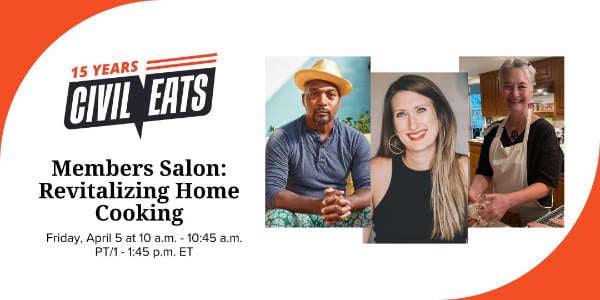
Join us for our upcoming salon about home cooking on Friday, April 5, at 10 a.m. PT/1 p.m. ET. Civil Eats’ Senior Staff Reporter & Contributing Editor Lisa Held will talk with authors and chefs Kim O’Donnel and Bryant Terry about the state of home cooking and why it is the cornerstone of a sustainable food system. Register now!
Afterwards, we’ll move to our Slack community to continue the conversation with O’Donnel and Terry from 10:45 - 11 am PT/1:45 - 2 pm ET. To join us there, please review the Community Rules and Agreements and accept this invitation link. (Here are the
instructions if you’re using Slack for the first time.)
|
 |
| Share Your Feedback in Our Annual Membership Survey We value your thoughts and would love your help in continuing to improve Civil Eats. We’ve put together a member survey to help us understand your experience with Civil Eats' membership and how we can better serve you. Please take a few minutes to fill out this survey. Your
support is so important to us, and your feedback will help us make Civil Eats even better.
Introducing Our New Member Spotlights
We're showcasing some of some of the remarkable people who support our work by highlighting how our members are making a difference in the food system, and how they benefit from being a Civil Eats member. Email us if you’d like to be considered for a future spotlight.
|
(Return to top)
|
|
|
|
Member Spotlight: Summer Grandy’s Path to the Food System
|
BY JIM COLGAN
|
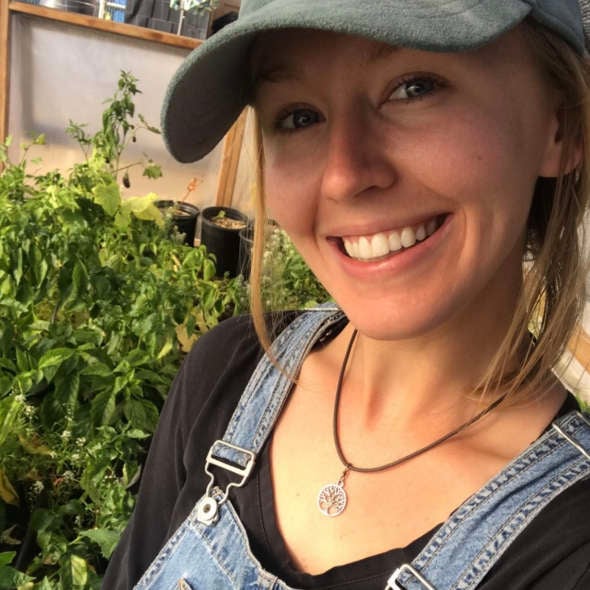 |
Summer Grandy wanted to be an architect when she was in high school. Even though she lived on a ranch owned by her grandfather in Boise, Idaho, going back generations, she had little affinity for the farming culture she grew up around. She spent her mornings feeding cows before class but had no interest in pursuing a career in the food system.
In her junior year of a career-oriented high school, a friend handed her a pamphlet about a foreign exchange program. She decided to apply, and that summer she moved to Costa Rica for two months to stay with a family that owned and operated a small farm. The experience changed her whole direction.
“It's the only time in my life when I would say I had a true paradigm shift,” Grandy says.
When she returned, she switched her attention to environmental science and attended the University of Portland, where she focused on food justice.
Now, Grandy, 28, has jobs at two different food nonprofits in Northern Arizona and strong opinions about food practices in rural and urban cultures.
She is a systems coordinator for Flagstaff Foodlink, which helps small growers in the region. She is helping complete an assessment of the local food system for the city of Flagstaff. She also works alongside the growers, connecting them with state and federal programs they might benefit from. “Growers are my heroes,” she says.
|
|
|
“I have never lived in a place where people are so devoted to making an impact on their food system.”
|
|
Her second job is as a client advocacy manager with the Flagstaff Family Food Center, a food bank serving the area. She is helping to create an anti-hunger department within the organization, with an ambitious goal to address hunger’s root causes. It’s still in the early stages, she says, but they are
starting by getting input from the people who rely on the organization for food.
Despite the diversity of food sources, food insecurity affects 10.3 percent of Arizonans, according to Feeding America. But Grandy says she is inspired by the efforts of the people working to address the issue. “I have never lived in a place where people are so devoted to making an impact on their food system.”
If she could change one thing, she says, it would be to tear down the silos between the people focused on food sustainability and those working on food access. “There’s no sustainable food system when your community is facing such a large rate of food insecurity at the same time.”
Her career in food so far has taken her through those different worlds. At an AmeriCorps project in Carson City, Nevada, she helped high school students grow food sustainably and deliver it to local food banks, which is when she first encountered food insecurity up close. “And then I kind of went directly into the opposite realm,” she says. She worked at a food co-op with a wealthy clientele, an experience that made her realize she wanted the kind of equity and food justice work she is doing now.
|
|
|
|
|
|
 |
Cooking Is Serious Business, but We Don’t Have to Take It So Seriously
Chef and food writer Kim O’Donnel says making your own food matters; making impressive food doesn’t.
BY LISA HELD
|
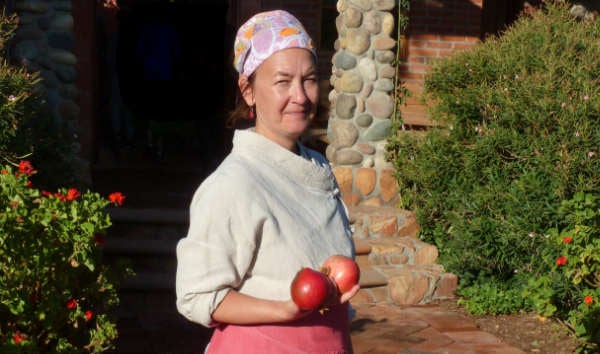
In a popular 2013 Civil Eats essay, chef, writer, and instructor Kim O’Donnel explained her philosophy of cooking as the cornerstone of a sustainable food system.
“The thing is, home cooking is serious business. It is a conscious decision to turn raw ingredients into a meal to nourish ourselves and the people we love,” she wrote. “The food system is more than crops and livestock; it’s what we humans do with them.”
More than a decade later, O’Donnel believes the connections between farms, our kitchens, and sharing food around a table are even more important. In the era of DoorDash, Instacart, and QR-code menus, when eating has become increasingly digital and passive, cooking can be a revolutionary act, she said, providing an avenue for active, sensory engagement with our own nourishment.
But that doesn’t mean the kitchen needs to be a realm of lofty pursuits. In fact, O’Donnel kept coming back to the opposite idea in a recent interview. To get more people cooking, she said, we need to “lower our expectations.” Instead of mastering a technique, learn basic knife skills. Instead of obsessing over a certain diet, give yourself permission to change things up.
We spoke to O’Donnel about these ideas, and she shared tips and tricks to turn cooking into a simple, rewarding, lifelong practice.
How do you describe your approach to cooking?
I am one of those people who can open up the refrigerator and figure out what we're going to have for dinner. My husband always marvels at that. I actually get great satisfaction from scrounging and coming up with something that tastes really good. I think about what I have on hand and how I can incorporate something that might be new. And what time of year is it? I do a lot of preserving, and so I have enough crushed tomatoes in jars that I can have at least one quart a month. So, recently, I yanked one of those, and I had some beans that I had cooked a few days before. I did a sort of a riff on a minestrone, but no pasta.
|
“I think of cooking as a practice in many ways, like any other practice that's good for your body.”
|
I don’t think about fancy. I think about something that's simple but feels really good in the body. I think of cooking as a practice in many ways, like any other practice that's good for your body. I've been practicing yoga for more than 20 years. And of course cooking is about the fuel for your body, but there's also something spiritually and emotionally nurturing. One could even say that when you cook for yourself and for others, you are parenting yourself or parenting somebody.
|
I cook the same way, but I think a lot of people find it intimidating and feel like they need to start with a recipe. Has that been your experience with students? Is it more challenging, or does it take more practice?
Good question. I'm thinking right now about this guy named Edward Espe Brown. He is a monk, but he also wrote cookbooks. Many years ago, I interviewed him. He kept talking about this idea of letting your hands be hands. In the age of handheld devices . . . can you just be in your five physical senses? I know that may sound very woo-woo, but he was pointing to this performance anxiety that our culture has around cooking.
There’s this whole notion of “think like a chef” or “mastering the art of . . .” There’s this yearning to make it more meaningful or to feel like, “Wow, that's a really big win, making that dish.” But you're putting a lot of pressure on yourself to recreate this thing on a weeknight when you might have worked. You might have had to pick up a kid. You might have had a really shitty day. Cookbooks are wonderful because they give us ideas and they inspire us. But are we being realistic?
What if we stopped and thought, “Is there something wrong with having an omelet for dinner? An omelet that takes five minutes?” And, “Oh, I have some spinach, I might have spinach in it.” You don't even have to have spinach in the refrigerator. You could have spinach in the freezer.
We get into these routines, and I would say, “Can we get another kind of routine into our week?” That is one of the reasons I loved the whole idea of Meatless Monday—it's about that incremental approach to the way you navigate your daily life. If someone says, “I've been really wanting to cook, but I don't know where to start,” they often think that they have to go from zero to 200 overnight. Why not just try one night cooking at home, something simple, and you have leftovers for lunch? And then maybe a couple of weeks later, you're doing two [nights].
You were one of the first Meatless Monday bloggers and have written multiple vegetarian cookbooks. Why vegetarianism?
My own story is a family history of heart disease, and I'm considering the environmental impact of livestock production on the planet. But I think that we need to and can figure out the things that are important to us and also have permission to change it up as we need to. There's no one-size-fits-all diet.
When I go out and teach, people think, “I have to do this. I'm gonna be a vegan now.” You could. Maybe being vegan is great for you. Or maybe you're gonna decide that you’re missing out on some nutrients. I feel like part of the values piece is that you make some decisions, and then you also should check in with yourself regularly.
|
“There's no one-size-fits-all diet. Part of the values piece is that you make some decisions, and then you check in with yourself regularly.”
|
I'm not a vegetarian, and yet I cook without meat more than half the time, anywhere from 50 to 90 percent. It depends on the season. When there are all kinds of produce that I can get where I live or from my garden, then there's much less of a chance that we're eating meat. Part of the value system is connecting with the seasons wherever you live as much and as best as you can. If you love apples and live near a source of apples, then eat an apple every day for as long as you can. You’re going to get so many benefits, and that's not even cooking—that's just taking care of yourself.
Is that what you mean when you say cooking is the cornerstone of a sustainable food system, or is there more to it?
I do feel like the more we cook with a degree of regularity—whether it's once a week or five times a week—we become more connected with the food system. When we are being cooked for . . . in a restaurant or at home, it is a very passive experience. It’s like the baby bird syndrome, right? We have our mouths wide open, just shoving it down as fast as we can. But when we cook for ourselves, we are active and using our five physical senses, and we are engaged in this process from start to finish. Then, I feel like there's no way that we don't become more attuned to how food is grown. What's a good strawberry versus not so good, for example, and it tunes you in to where you’re living.
You don't have to be as sensory and passionate as I am. But there is something that happens. Even the simplest thing. You make a vinaigrette in a jelly jar and shake it up and you have your arugula from the clamshell. You're still doing something. And when you cook something and you invite somebody to your house or maybe you're taking some soups to somebody who's not feeling well, there's a ripple effect.
What’s a dish you come back to that exemplifies that approach?
There is a Paula Wolfert recipe in the book Unforgettable. It’s a bulgur dish with any greens; it could be spinach, chard, kale, collards. There's a little bit of onion, olive oil, some smashed garlic, and some harissa. You massage it, a paper towel goes on top, and you put it on the stove for 30 minutes. It’s that dish that you can have with salmon or just feta, or you eat it cold the next day with a fried egg. I make that a lot.
One of the other things that has become a go-to is just getting red cabbage or green cabbage and massaging it and squeezing some lime, salt, maybe oregano. It’s like magic.
|
(Return to top)
|
|
|
|
|
 |
5 Tips for Grocery Shopping With Your Values—and Budget—in Mind
|
BY CHRISTINA COOKE
|
Shopping for groceries can often feel daunting, especially if you’re considering how your food choices impact your health and the well-being of the planet while also dealing with the very real constraints of time and money.
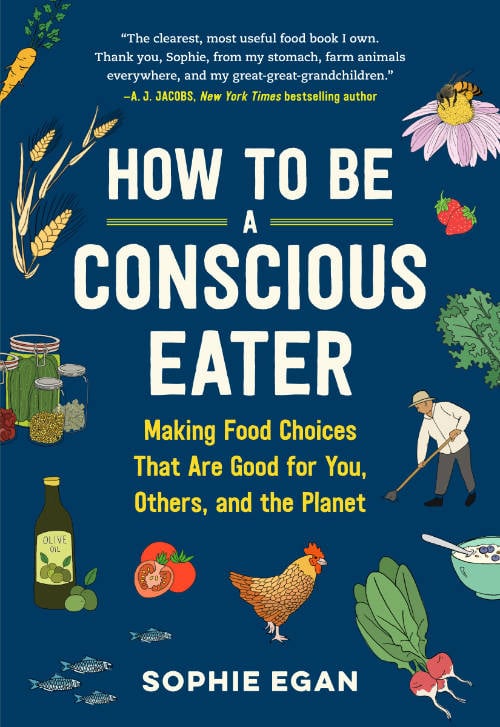
Sophie Egan, author of How to Be a Conscious Eater: Making Food Choices that Are Good For You, Others, and the Planet and former director of Health and Sustainability Leadership at the Culinary Institute of America, offers advice for how to shop for the benefit of yourself, others, and the environment—without feeling guilt for the compromises you have to make.
Here, Egan shares some key concepts as you strive to align your food shopping choices with your values.
Your shopping choices CAN make a difference in planetary health.
Embrace the incredible power of food choices as a daily climate solution. There's an incredible call to action from leading global scientists, Project Drawdown in particular, which tells us that of all the climate solutions, the number one is reducing food waste. Number two is eating a plant-rich diet. And what I find so exciting about that is it's something that every individual can contribute to on a daily basis.
|
|
|
Eat more fruits and vegetables, but drop the binary,
all-or-nothing mindset, and don’t let perfect be the enemy of good.
There’s too much black-and-white messaging and all-or-nothing mindsets. You do not have to go vegan to eat sustainably. As an individual or household, the more you're generally aiming for plant-positive, plant-centric, flexitarian—basically just general emphasis on the delicious, abundant diverse foods from the plant kingdom—that’s great.
|
|
 |
Author photo credit: Cristin Young
|
|
|
It’s a win-win that’s good for the planet and your health. It’s far more impactful to be a flexitarian for life than vegan for one summer.
One in 10 Americans eat the recommended value of fruits and vegetables. I often hear, “I don’t buy organic blueberries because they’re too expensive. So, therefore, I just don’t buy blueberries.” The perceived hierarchy of produce just gets in the way of people eating more of it, in any form.
I think whatever way you can enjoy access to fruits and vegetables—frozen, canned, if you grow them yourself—great. If they’re organic or regenerative—great. Truly, just eating more—some, any—is better than none. Applaud yourself for eating foods that are supportive of your health and planetary health in whatever ways you have access to, and in whatever frequency is viable for your budget. The goal is not 100 percent perfection.
From my perspective, conscious eating—trying to eat healthy, sustainably, equitably—is not about a diet. It's not about hard-and-fast rules. It's not about a no-no list or self-righteous over-emphasis on only a few foods. It’s not about giving up the foods you love. Food is also joy and deliciousness and heritage and family and connection and community. And don't have blinders on in the pursuit of more sustainable eating to crowd out those things that are equally important.
|
“Applaud yourself for eating foods that are supportive of your health and planetary health in whatever ways you have access to. The goal is not 100 percent perfection.”
|
Make small, strategic changes in your shopping habits that add up to the biggest cumulative impact.
Start with the things you do frequently, the food you eat often. Don't stress about what you eat on holidays or vacation or birthdays or when you're traveling and so forth. It's really the routinized, regular items. What do you and your family eat every weekday for breakfast? What's your Friday dinner ritual? What are the 10 things that you always buy at the grocery store? That's where the biggest cumulative impact of you as a conscious eater is really worth the effort.
Start with a simple swap. So, if my weekday lunch is a turkey sandwich every day, look at a couple of times a week swapping avocado toast or a bean-dip sandwich or pita and hummus.
Shop at whatever store is accessible and fits within your budget, and seek out the healthy, sustainable choices there.
If you have to take two buses to get to a certain store and there’s another store you can walk to, that’s a relevant consideration. It’s not just more expensive co-ops and Whole Foods that have healthy, sustainable foods. A tub of plain oats from anywhere is a phenomenally healthy food. Same for a bag or can of beans. Keep in mind that although some stores are full of highly processed junk foods, pretty much all of them tend to have those staple whole grains, legumes, frozen vegetables, and fruits. Sometimes you may just feel more like a salmon swimming upstream to locate them.
Look for trusted third-party certifications.
Third-party certifications can be the referees of values-based marketing claims. If your goal was to have eggs from chickens that are not just cage-free, but truly have more space and are pasture-raised or in more humane living conditions, you would look for a third-party sticker such as Certified Humane Raised & Handled.
|
|
|
It's not that everyone is expected to memorize all the little stickers. It’s just to know that when there is a third-party entity, it means they went to the trouble of auditing against an evidence-based standard that they deem worthy of the marketing
claim, as opposed to taking the company's word for it.
Editors’ note: Egan shared with Civil Eats readers an excerpt about labels from her book.
|
|
|
In “Stickers to Know,”
she explains the various certifications you might encounter as you shop. From Certified Organic to Biodynamic to Animal Welfare Approved, she offers this guide to what each certification does and does not mean, who is behind it, and why it’s legit.
|
(Return to top)
|
|
|
|
|
|
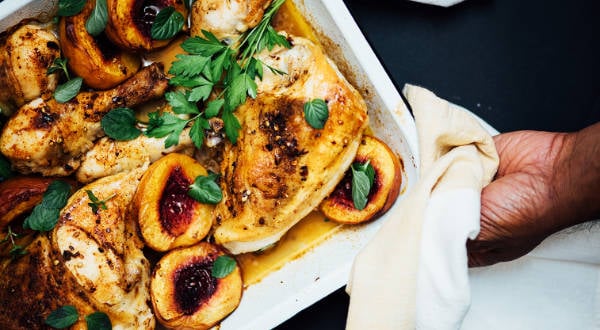 |
Roast chicken with citrus and peaches. (Photo credit: Nik Sharma)
|
Nik Sharma’s Tips to Fight Recipe Fatigue
|
BY MATTHEW WHEELAND
|
Whether you’re a chef, cookbook author, recipe developer, or home cook, the act of cooking—not to mention preparing to cook and cleaning up after—can sometimes be a slog. Whether you’re trying to cook with the seasons and facing yet another market basket of leeks and spinach, or you’ve hit a rut with recipes, cooking can become exhausting. Cookbook author Nik Sharma is no stranger to the challenges of recipe and cooking fatigue: His latest,Veg-Table, is focused on putting produce at the center of the menu, which can require more prep and clean-up, two of the more time-consuming aspects of cooking.
Recognizing that, we spoke to Sharma recently about his approach to keeping cooking interesting, engaging, and joyful. Here are some of his favorite tips.
Seek out entertainment while you’re cooking.
There are non-cooking things you can do during cooking. When I cook, for example, I'm either listening to my favorite soundtrack, or I'm watching a show—something on design, or something silly like the “Real Housewives.” But it has to be something unrelated to what I'm doing at the moment, so I don't get fatigued and bored and tired and fed up.
Add meaning with non-food elements.
|
|
|
One of the things recipe writers do a lot is to get
inspiration from other people or countries. So when you travel or you go to a restaurant, try to remember things that you enjoyed. I learned this from author Diana Henry, who is known for romanticizing meals beautifully. She loves to collect tablecloths and cute little wine glasses, and they’re all mismatched, but there's a story behind everything and it brings back memories during a meal. It doesn't have to always be the dish that creates the memory for you.
|
|
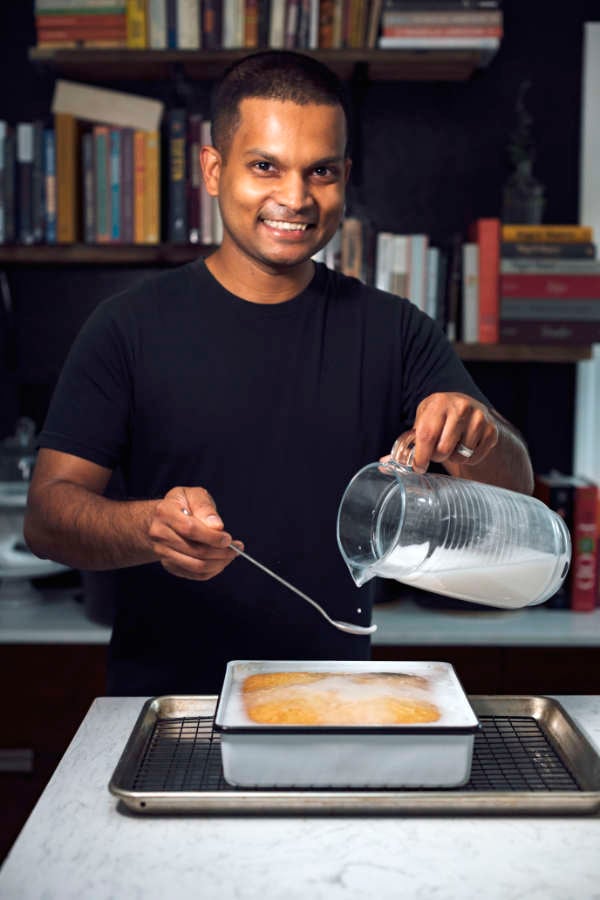 |
Photo credit: Nik Sharma
|
|
|
Cook the same foods in different ways.
Although there’s a lot to be said about the joys of cooking seasonally, there are some downsides too. I did a CSA [community-supported agriculture program] when I lived in D.C., and they would send us lettuce all the time. I once found a recipe for a French lettuce soup just to try something new, and it was the most disgusting thing. Even in California, you can get the same things all the time in season. It does get boring.
This is where there are easier fixes: Suppose you're making potatoes two times a week. Maybe you change the method of cooking—one day you roast them; the other time you boil them. Or maybe you use the same technique, but then you can switch the spice plan. Spices are the easiest way to revamp a meal, to make something familiar more exciting—you roast potatoes with salt and pepper one time, then in harissa the next time, and maybe the third time use garam masala.
|
|
|
There’s no shame in shortcuts.
I tell people, if they want to make it easier, if the budget allows, go and buy pre-prepared, pre-cut ingredients, it's OK. It's a little more expensive. But
if you can, do it if it makes your life easier. There's no shame in taking shortcuts.
One of the pressures, especially in countries where we're privileged enough to get access to ingredients all the time, is that there is a shame around buying canned foods and frozen foods. There are definitely good quality brands that are already prepared, so you don't have to soak your beans and stuff like that.
Frozen foods can actually be nutritionally better than fresh foods because the vitamin content often lasts longer. If you buy a whole vegetable, depending on the time it takes to get from the farm to the market, the nutritional quality keeps decreasing as soon as it's pulled off the plant. With frozen vegetables and fruit, it’s flash-frozen, so the nutrients don’t degrade as
fast.
Simplify your prep.
If you're actually going to sit and cut everything, it's OK to prep the night before. If you want to spend a few hours on a Saturday or Sunday prepping for the week, it’s totally fine to prep and freeze. And if you have a food processor, those chop up pretty nicely—it’s easy to use tools like those.
I know professional chefs and recipe developers always encourage people to do the mise en place, like, get all your ingredients ready in separate bowls. And people don’t like to do this because then they have to wash more dishes—and the mental notion of washing a lot of dishes is just off-putting. Just have the ingredients in front of you at the table in the kitchen and work with them.
|
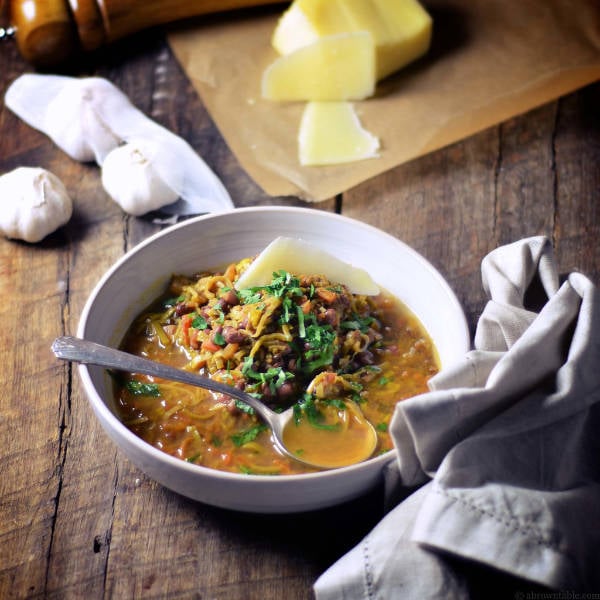 |
Aduki bean and black lentil soup. (Photo credit: Nik Sharma)
|
It’s not about looks.
Instagram, Pinterest, and all these things are all responsible for this desire for everything to look perfect—and of course I'm partly responsible for it, too, because I always have to take a good photograph or video to sell the product.
|
“No one's coming to your house to judge you. As long as it tastes good, it's fine.”
|
But you also have to keep it real. For me, it's a professional challenge. I just tell people directly, don't be ashamed of how it looks. Because first of all, no one's coming to your house to judge you. As long as it tastes good, it's fine.
Kosher salt is silly.
Another thing home cooks hear all the time is, “You have to use kosher salt—Morton or Diamond.” It's nonsense, because that's not going to make them a better cook. There's nothing magical about it. And it's infuriating to me because, first of all, the price of those salts are actually quite high compared to just regular sea salt.
Some chefs will say, “Oh, I can grab kosher salt better.” You can also grab fine sea salt better, unless your fingers are made of, like, stainless steel, right? And some chefs will say, ‘It dissolves really fast.’ But I did a time experiment side by side and there was no difference. Telling people to use something so specific, when it's not going to make them a
good or bad cook—it’s silly.
Don’t go overboard so you can actually enjoy the meal.
We do a lot of this to ourselves—we're trying to replicate what's online or what's in a restaurant, and you don't need that at home. You can just have a lovely meal, entertain your guests properly. When you're entertaining or feeding your family, don't go overboard, because at the end of the day, you actually want to enjoy the meal and spend time with them.
Accept help, including from kids.
If you can, get help from family members or friends. Maybe not even meal prep, but putting things away, cleaning up, setting the table—take it, take it. You don't have to do it all yourself, especially if you have kids. One of the things that I enjoyed as a child was always being asked to be part of what I call transformational steps in cooking.
My grandmother would do this thing whenever she was making sweets for
Christmas. In India, it's a huge process—there's a month-long thing for Christmas and Easter where the Christian community does sweets. My family would start a month ahead of time. And I would be involved always at the end stage where we were shaping sweets; as a child that was always fun. Or when my grandmother was making something savory, again, that involves assembling.
In Veg-Table, there's a recipe for her cabbage rolls; that's a dish that I learned from her because it was so much fun to do, stuffing things and rolling leaves. And I call those transformational recipes because, as a child, you start to get fascinated by your ingredients. They're changing in front of you. You're actually involved at the end and, as a child, you can say, “I made that.”
|
(Return to top)
|
|
|
|
|
|
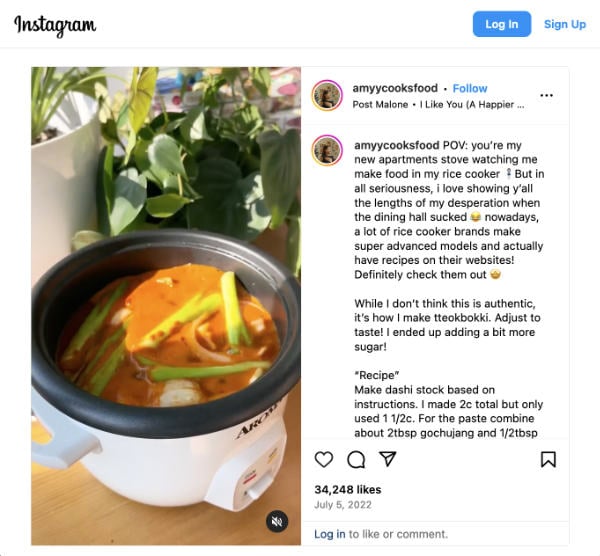 |
amycooksfood's rice-cooker tteokbokki.
|
Cooking in Small Spaces: The Golden Age of Dorm-Room Cooking
Social media has opened up a new world of possibilities for dorm-room dining.
|
BY GREY MORAN
|
In a mostly dark dorm room, a narrow beam of light illuminates the makeshift table: a white towel spread over a bed. A pair of hands prepares filet mignon, using just a cutting board, basic utensils, a crockpot, and a blowtorch. The hands sear a slab of tenderloin steak with a flash of blue flame. A Nicki Minaj–Ludacris mashup is punctuated by the sounds of fast-paced cooking: the grinding of sea salt, a flick of a cap of oil, the sizzling of the steak in a crockpot with melted butter, a heap of garlic, and a twig of rosemary.
The final scene: A knife glides into the perfectly tender and crispy filet mignon, prepared without ever leaving the dorm room bed.
This 15-second video, by TikTok user Lazy Pot Noodle, has amassed more than 2 million views and even garnered the attention of renowned chef Gordon Ramsay.
In a response video, Ramsay takes on the voice of a sports coach, cheering and predicting the young chef’s next move: “Yes! Stop it! Basting. Beautifully done. Butter,” he shouts, squinting at the steak bathedin butter. “Oh my god, this kid knows what they’re doing!”
When it’s ready, Ramsay announces that it’s time to take the steak out, and the student follows right on cue. “Baste it with the resting juices,” he instructs. Like clockwork, the hand does exactly that. “Kids, what happened to the $3 ramen?” asks Ramsay. “We’ve been upgraded to a five-star steak!”
As Ramsay observed, we’re now living in the golden age of dorm-room cooking. Thanks to social media platforms facilitating the exchange of cooking hacks, students have figured out how to adapt recipes to the dormitory, without kitchen appliances. They’ve become masters of crock pots, easy-bake ovens, cheap cutting boards, and portable electric burners, while maneuvering in a tiny space. While campus cooking is hardly a new trend, this generation of college students has a fresh stage and audience—even celebrity chefs may tune in—to swap notes, recipes, and typical internet babble.
|
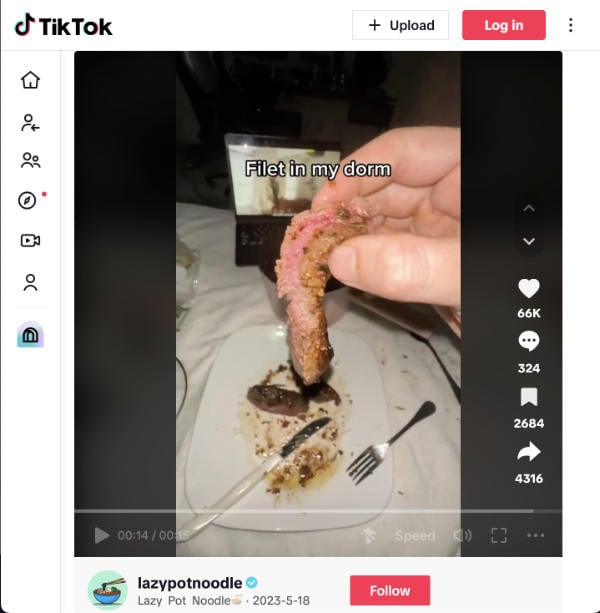 |
Lazy Pot Noodle's filet mignon .
|
Some of these dishes stretch the boundaries of what was thought possible for on-campus cooking, like the filet mignon. Yet much of the genre is also focused on practical, affordable meals that can be easily replicated outside of the dorm room, broadening the possibilities for all budget- and space-constrained chefs. These low-budget, accessible, and creative dorm-room meals are opening up new possibilities for all cooks with limited kitchen access, from low-budget travelers staying in hostels to anyone struggling with housing insecurity to housemates tired of waiting for their turn to use the oven. All it takes is an easy-bake oven, and a dash of confidence, to prepare a
delicious, kitchen-free meal.
|
Students have become masters of crock pots, easy-bake ovens, cheap cutting boards, and portable electric burners, while maneuvering in a tiny space.
|
“That easy-bake oven is putting in WORK,” said one TikToker, in response to Lazy Pot Noodle’s Thanksgiving dinner. “He’s so tired,” quipped the dorm-room chef about the little pink oven that had just cooked up turkey, stuffing, baked mac and cheese, and mashed sweet potatoes topped with golden-brown marshmallows. “You did better than folk with a WHOLE kitchen,” replied another of the young chef’s fans.
Lazy Pot Noodle’s videos reveal that just about anything can be prepared in a small, kitchenless room, with equipment no bigger than a microwave, from shabu shabu to jambalaya to mini pizzas. The chef also has some more classic college essentials, like
spruced-up boxed mac and cheese and ramen.
There’s a growing world of social media users preparing just about anything under the sun from the comfort of their dormitories. For Lazy Pot Noodle, this has turned into a job, earning income from sharing links to the cooking equipment, ranging from $30 to $80. But other social media chefs are simply sharing to swap knowledge on how to cook in the confines of a dorm room.
In another series, then-college student Priyamvada Atmakuri prepares budget-friendly recipes, often from the desk of her dorm room, including apple crumble in the microwave, peanut and coconut tofu curry on an electric burner, zesty and creamy lemon pancakes,
and quinoa salad with kale and spicy chickpeas.
“This is way more elaborate than anything I’ve made in my dorm room so far, but oh my god, it’s so worth it,” she wrote in 2022, describing her curry noodle soup video. “It’s so filling and comforting, and it’s just what one needs on a cold afternoon.” Since her college cooking days, Atmakuri has become a professional pastry chef for a restaurant in India, while operating an at-home bakery by herself and
still sharing recipes on Instagram.
Another TikToker, amycooksfood, has become known for her rice cooker series, based on meals prepared in her college dorm room. “To be totally honest, my dining hall wasn’t very good. My college luckily allowed rice cookers,” she explains in a video.
“So, I tried making thịt kho tàu with a rice cooker, and from then on, I learned that you can use a rice cooker for anything.” She uses a small, no-frills rice cooker, she explains, to keep her recipes accessible for low-income college students who can’t afford fancy equipment.
|
Amy’s series includes Japanese curry, tteokbokki, miso soup, soft-boiled eggs, and even banana bread from a dependable rice cooker. In her video for budae jjigae, a spicy stew from Korea, she explains the origins of the dish in a caption: “This dish was created from leftover processed foods from U.S. military bases in Korea during a time of extreme food scarcity,” she wrote. “It’s a symbol of adaptation and resourcefulness necessary for survival.”
This generation of dorm-room chefs are showing that you don’t need a glossy, high-end kitchen to make good food. In fact, you might not even need to leave your bed.
|
(Return to top)
|
|
|
|
|
|
 |
Getting Schooled on Preserving and Storing Food with Civic Kitchen
|
BY TILDE HERRERA
|
San Francisco's Civic Kitchen buys enough fruits and vegetables every month to completely fill 10 shopping carts. More than 250 students take classes each month at the school, which is geared toward home cooks. In the last year, inflation has driven up Civic Kitchen’s food costs by 10 to 15 percent, says co-founder and instructor Jen Nurse.
"We're super concerned with the longevity of what we bring in and don't want to waste it, so we have all kinds of storage techniques," Nurse says.
For example, the cooking school, like all professional kitchens, uses the first in, first out (FIFO) system so that the oldest food in its refrigerators, freezer, and pantry are used first.
Below are more food storage and preserving tricks and hacks from Civic Kitchen and 18 Reasons, a San Francisco nonprofit that promotes home cooking to increase food security.
Produce. For many types of fruits and vegetables, the key is to wash, dry, and store them in the refrigerator or pantry. After Civic Kitchen receives a produce order, for example, they fill a sink or large container with cool water and add most types of fruits and vegetables (see note below on berries) to soak before scrubbing everything—Nurse loves using Japanese tawashi brushes—and laying them out to dry completely on a wire rack or towel without touching. "If we do that and store in our pantry or fridge, it lasts a really long time and anything you reach for is already
clean," Nurse says.
Tomatoes and potatoes can be washed and dried but shouldn't be stored in the refrigerator. Potatoes can go into a brown paper bag once dry to shield them from light, which turns them green. Onions don't need to be washed before storage or refrigeration. If your mushrooms are very dirty, wash them (quickly, to keep them from soaking up water) right before use.
Ethylene gas is released as produce ripens and can speed up ripening in nearby produce. Onions produce a lot of ethylene, so Kayla Whitehouse at 18 Reasons recommends storing them away from potatoes. Bananas also ripen quickly and produce ethylene, so store those away from apples.
Berries. For delicate berries such as strawberries or raspberries, Nurse spreads them out, unwashed, on a paper towel-lined sheet pan in a single layer, without touching. Then she layers another paper towel on top, followed by a layer of plastic wrap. Finally she stores them in the refrigerator to be washed right before using. For sturdier berries, such as blueberries and blackberries, she'll follow the same procedure but washes and dries them first.
Herbs. Nurse advises against washing fresh herbs directly under hard running water, which can bruise the leaves. Instead, fill a large bowl or sink with cold water and float the herbs for a while. Lift them out and use a salad spinner to dry them as much as possible. For multiple kinds of herbs, nest a dry towel between the bunches in the salad spinner to keep from getting mixed up. Gather the stems in the same direction like a flower bouquet. Store the herbs upright in the refrigerator in a container with a little bit of water covering the stems. Or wrap the stems in a paper towel folded lengthwise, keeping the leaves loose, and store in an airtight container or Ziploc bag. "You throw a few bunches of herbs in there, squeeze out the air, zip it
up, and it will last for at least two weeks," Nurse says. This technique doesn't work with basil, which should be washed right before using—and never refrigerated.
|
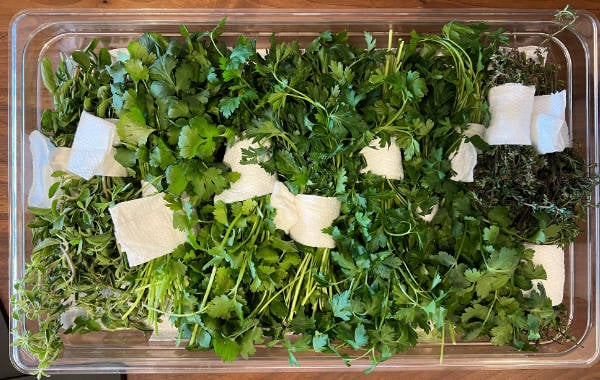 |
Herb storage photo courtesy of Civic Kitchen.
|
Ginger. Civic Kitchen stores half-used ginger in the freezer with the skin on. "You just grate it or use it straight from frozen, and it's wonderful," Nurse says. She notes that it's easier to grate with the skin on and recommends choosing young ginger with fresh, fine skin and washing it before using.
Animal Protein. Most raw proteins last longer in the refrigerator than people think, Nurse says. She recommends buying and cooking fish within a couple days, and within three to four days for other types of protein. Throw out food if it smells off or looks discolored. Once cooked, most proteins will last three to five days.
Freshness. Nurse noted there can be a big difference in freshness and shelf life of what is available at a farmers' market or farm stand vs. the grocery store. "I can say absolutely without a doubt that the produce and herbs from the farmers' market typically last at least twice as long as what you get in the grocery store," she said. Although some things may be cheaper at a grocery store, buying from a farmers' market or farm stand also ensures that more of your dollars are going directly into farmers' pockets.
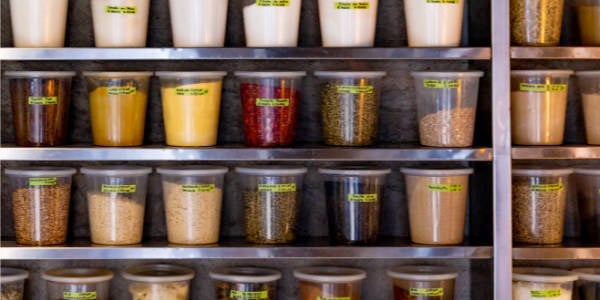
Storage containers. Nurse recommends using clear, airtight containers that are stackable and nest well with each other, such as square- or rectangle-shaped containers rather than round ones. Although some people steer clear of plastic due to safety concerns, Nurse doesn't have a problem with food-grade plastic containers like Cambro. She advises placing labels in the front of containers, rather than on top, so you can quickly see what needs to be used first.
|
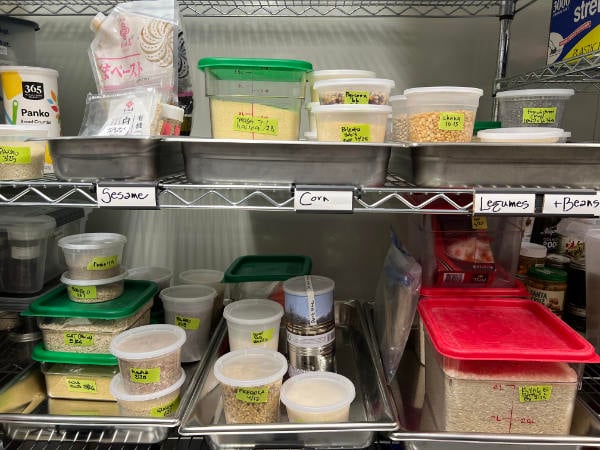 |
Labeled foods in Civic Kitchen's pantry. (Photo courtesy of Civic Kitchen)
|
|
Freezing. If you can't cook your food or eat your leftovers in a timely manner, "your freezer is your friend," Nurse says. Whitehouse recommends blanching vegetables before freezing them to retain texture and flavor; she also recommends buying frozen vegetables to save money on out-of-season
produce. Overripe bananas can be frozen with or without their skin and used in smoothies or banana bread.
If using Ziploc bags to store food in the freezer, Nurse says it's important to squeeze out as much air as possible because many freezers are designed to cycle through freeze and thaw periods; as they cycle up and down in temperature, food will refreeze, which can lead to freezer burn if the food is exposed to air.
Preserving. Extra onions and other vegetables can be pickled with a quick brine, which will extend their life for a month and provide fun toppings for tacos and sandwiches. Onions can also be caramelized, which will keep for a week or be frozen. Lemons preserved in salt and sugar can add a kick to salad dressings, sauces, cocktails, and marinades. For herbs about to turn, Nurse recommends making a simple
green sauce that can be added to meat, sandwiches, pasta, or dressing, or can be frozen for later use.
Avoid the danger zone. Nurse advises home cooks to beware of the danger zone, the 40° F to 140°F range in which bacteria can quickly grow. The saying goes, “Keep hot food hot, and cold food cold.” Food safety experts recommend discarding perishable food that has been held in this temperature range cumulatively for more than four hours.
|
(Return to top)
|
|
|
|
|
|
 |
Author photo credit: Aaron Stern
|
Loving Your Leftovers With Tamar Adler
|
BY NAOMI STARKMAN
|
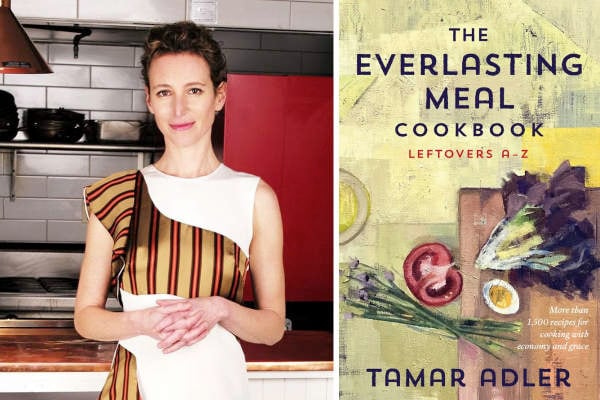
When I called Tamar Adler at her home in Hudson, New York, to talk about cooking with leftovers, the James Beard award-winning cookbook author and chef was feeling very on-topic—and incredibly accomplished: She had just finished turning an “about-to-topple, structurally unsound, totally intimidating corner” of her kitchen full of stale bread ends into breadcrumbs. And although Adler expressed her dislike of quick tips, she offered some of her top ideas for rethinking our relationship to food in the
kitchen.
See food on its own terms.
“I think that seeing every piece of edible food you bring into your house on its own terms is a really important thing,” Adler says, offering as an example the old scallions she had originally bought to make fresh salsa. She was tempted to discard them, but realized she could swap them in for an onion to start the soup she was about to make. “But that requires seeing them for what they are now—which is still a perfectly good onion. Or even the bread I just finished turning into breadcrumbs, which will be enormously useful and will save me money and trips to the store buying panko. That requires seeing the potential in old bread, which is no longer good for slicing or toasting because it's rock hard but is still good for a different
purpose.”
And the way to start seeing food for what it is, Adler says, starts by giving every food the benefit of the doubt. “It’s about not deciding that just because something looks bad or old, it's unusable,” she says.
Focus on one food at a time.
“I feel like the professionalization of cooking and the focus on various cooking experts may do a disservice to new cooks,” Adler says. She urges people to trust themselves, even though they might not be great at making the most beautiful, Instagram-ready dishes. Adler advises simply learning how to cook individual foods, like carrots, by transforming them from raw to cooked, rather than trying to make them into a complicated sheet pan dish with other ingredients. “Just focus on turning carrots from raw to well-seasoned and cooked,” she says. “Make sure that they have enough salt and fat on them, and that they're totally cooked and tender. That's enough to focus on.”
Necessity is the mother of invention.
Adler also recommends that people don’t keep their pantries and refrigerators chock full of food. “You will never figure out, for example, that you can use cashews instead of almonds unless you let yourself run out of almonds,” she says. “That's the best way to learn. And you might not even have the energy or the realization otherwise.” She says shopping less, and insisting that what you have is enough, is a good approach to becoming innovative and experimental.
By way of example, she explained her process for the clam chowder she was planning to cook. The recipe, which she was improvising based on existing ingredients, included two pieces of leftover bacon, the aforementioned old scallions, and clam liquid from a dinner earlier in the week. Add some cream, and voilà—clam chowder.
Resources for food reinvention.
Adler’s latest cookbook, The Everlasting Meal Cookbook: Leftovers A-Z (which we featured last year on Civil Eats), is an encyclopedia of more than 1,500 recipes for leftovers. Looking up “scallions, old” in the index reveals a number of options. “I think over time you learn that the old scallion recipes and the old onion recipes both start with cooking the ingredient down. Cooking a wilted vegetable is a very good way of restoring your confidence.” Adler notes there are also some potentially helpful new tools coming available: We explored the new AI recipe assistant Taste Bud, which was developed by two home cooks in Atlanta. While it was a bit buggy, we did manage to get a recipe for some promising-looking scallion pancakes.
|
|
|
|
|
 |
Cooking Tips From the Civil Eats Team
|
INTRO BY LISA HELD
|
Perhaps unsurprisingly, many of the Civil Eats’ team are enthusiastic home cooks. Some of us have been to culinary school, some have picked up favorite recipes from their parents, and others have found inspiration in the wide world of recipes and how-to videos now available online. Here, the team shares some of the best tips and tricks we’ve learned along the way. We’d love to hear your tips as well—send us an email!
When it comes to home cooking, we all pick up knowledge in different ways.
Part of my story involves marrying an award-winning chef. (I know, what a brag.) In almost all ways, it’s a dream. He cooks for me constantly, and for that, I am unceasingly grateful.
But for an enthusiastic home cook, it can also be complicated. I love to cook and always thought I was pretty good at it. But when we first got together, my “skills” suddenly seemed ridiculous. I was filled with anxiety chopping vegetables in his presence and terrified any time he took a bite of a dish I’d made. (To be clear, he is only ever supportive and uncritical; it’s just about my internal desire to measure up in all ways at all times.)
Over time, that fear was whittled away by love and partnership. And along the way, I got better at cooking. The best part is that the pure joy he gets from making and sharing something delicious rubbed off on me. While some people dread the question, his eyes light up when he asks (sometimes literally at 10 a.m.), “What do you want to have for dinner tonight?” But I also use more salt and pepper than I ever did before and know how to make many more simple condiments. (Try this: diced white onion, cilantro, lime juice.)
“One extra step.” If time is the only variable that matters, you can live without this. Especially because yes, there will be more dishes. But one thing I noticed is that chefs always add an extra step that happens before the main “cooking” event. I never would have bothered with it in the past, but I have realized it can really improve the outcome. For example, boiling hard vegetables like potatoes or broccoli that are going to end up sautéed, roasted, or fried. Or sweating eggplant: Cover slices or dices with plenty of salt, let it sit for 20 minutes, put it in a towel, and squeeze out the water. —Lisa
A final touch. I used to laugh at the idea of carefully plating or garnishing a weeknight dinner for two, but there is something so lovely about someone putting a plate in front of you that looks like it was made with care. The most simple bowl of rice and beans comes to life with a little cilantro garnish on top.—Lisa
Garlic oil at the ready. For years I have sautéed garlic in olive oil before using it in pesto or other sauces that don’t get cooked; it mellows out the flavor and significantly reduces my garlic-breath woes. For the last six months or so, I have been doing that “one extra step” that Lisa mentions and sautéing more garlic and oil than I immediately need, and keeping the extra in a jar on my counter. Being able to quickly add garlic oil to any dish makes it a little more magical, and it makes pesto that much quicker to whip up. —Matt
Storage and presentation. Anything that’s getting stored in the fridge gets masking tape with an ID and a date. It takes two seconds, and I think it really does help you make sense of what’s in your fridge, which helps you come up with dinner plans more quickly and avoid food waste. —Lisa
Consult internet experts. When I want to figure out how to make something come out great, I go to YouTube to find tricks. I recently learned how to make fluffy omelets and how to pop the best popcorn every time! —Kalisha
|
 |
4 words to cook by. Samin Nosrat’s principle of “Salt Fat Acid Heat” is really helpful for figuring out how to cook and season to taste. It’s the idea that good-tasting food strikes a balance between salty, fatty, and acidic elements, while also considering how it is cooked (heat). So if the food doesn’t quite taste right, it’s likely one of those factors needs adjusting. —Grey
Look to simple, veggie-forward recipes for inspiration. We got into a rut with menu ideas to prepare for two kids and with limited time. We found ourselves making pasta, tacos, or a plate of rice and roasted vegetables over and over, ad infinitum. While we're not ones for prescriptive diets, we've recently found inspiration with Mediterranean-diet-inspired recipes, which prioritize vegetables, whole grains, legumes, and heart-healthy fats. The new ideas have spiced up our rotation: spinach and feta frittata! Lemony roasted shrimp and asparagus! Tuna melts! The variety has been refreshing, and the kids have been happy. We look for recipes that are simple and require as few ingredients and steps as possible. —Christina
Simple, high-quality ingredients. The one tip I share the most is really the simplest: Buy the best ingredients you can afford and let them shine. Because I don’t eat meat, I often spend more on fresh vegetables at the farmers’ market as well as high-quality olive oil—and I use a lot of it. People often seem amazed how really good olive oil can transform vegetables, not only in cooking and roasting, but also as a finishing touch and in salad dressing. Caramelized baby cauliflower, fennel, spring onions, and carrots, for example, can be transformed into a simple delicacy with a peppery olive oil and salt. —Naomi
Cook with, and for, friends. The Civil Eats team is tired of me talking about my soup swap, but it’s one of my favorite cooking improvements in the last few years. Throughout the winter, a neighbor friend and I exchange a quart of soup every week. I’ll make a slightly larger pot of soup—which takes almost no extra effort—and I get an extra meal by swapping with my neighbor. It’s like two meals for one! Plus, I get to try a bunch of recipes that I never would’ve discovered on my own. —Matt
For kids, find recipes that can be deconstructed. With two kids, ages 3 and 5, who each have particular tastes, we look for recipes that sound tasty to my husband and me—but can be served in deconstructed form as well. That way, we can enjoy the whole dish as intended, and they can enjoy the individual components they find most appealing. We recently prepared a variation of this farro, chickpea, spring veggie, and feta salad, for example. While we ate the marinated salad all mixed together, the kids enjoyed farro, roasted chickpeas, and slices of avocado, and could avoid the
radishes and lettuce, which they were less likely to eat. —Christina
Finishing touches. Ice cube trays are great for freezing small portions of extra sauce; the cubes can be stored in a Ziploc bag in the freezer. For example, you can pull out a few cubes of stock, pesto, or chile sauce for a quick addition to a dish. We also typically have fresh herbs, citrus, and good olive oil and butter on hand for finishing a dish. —Tilde
Preserving family memories. The act of passing on a family recipe can often be forgotten or put off for years. Sometimes it’s best to be the initiator and ask to learn how to make your mom’s famous chimichurri or arroz con pollo. Not only will seeking guidance on how to prepare beloved dishes allow another generation to experience the love of cooking that spans decades, but it will also honor the cooks themselves. Take this as a sign to ask that family member about their iconic dish and then be sure to pass down the knowledge in your own time. —Marisa
All interviews in this issue have been edited for length and clarity
|
(Return to top)
|
|
|
|
|
|
That's all for this issue of The Deep Dish. Thank you for reading, and thank you for being a member of the Civil Eats community. If this is your first time reading The Deep Dish (welcome!), be sure to check out our previous issues:
If someone forwarded this email to you, please support our work and become a member today. Questions? Compliments? Suggestions? We love to hear from our members: Please send us a note at members@civileats.com. |
(Return to top)
|
Did you enjoy this newsletter? Help us out by forwarding it to a friend or sharing it on Facebook and Twitter.
|
|
|
|
|
|
|
|
|